Choosing among food mills for small businesses means balancing throughput, texture control, cleanup, and available workspace. The right model can help streamline sauces, purées, jams, applesauce, and canning prep without overinvesting in equipment.
This roundup compares 10 manual and electric options, including stainless steel commercial mills, multi-disc designs, and higher-capacity tomato-processing machines.
Best 10 Food Mills for Small Businesses Picks for 2026
Hand-Crank Versatility
Hungry Artisan 3-Disc Food Mill

- Three discs provide coarse, medium, and fine textures.
- Manual operation needs no outlet.
- Stainless steel construction supports repeated use.
Best For: Small-batch applesauce, sauces, purees, and canning
Stable Countertop Processing
OXO Good Grips Stainless Steel Food Mill

- Three discs handle fine, medium, and coarse textures.
- Non-slip legs fit pots and bowls up to 11 inches.
- Folding legs simplify storage.
Best For: Hot-food purees and sauces in batches up to about 2.3 quarts
High-Volume Electric Straining

- One-gallon hopper supports larger processing batches.
- 250-watt motor includes forward and reverse speeds.
- Three screens cover fine, medium, and chunky textures.
Best For: Tomato sauces, salsa, jams, and preserving in larger batches
Commercial-Style Manual Milling
Winco 9-Inch Stainless Steel Food Mill

- Corrosion-resistant construction suits professional kitchens.
- Interchangeable plates support varied textures.
- Two-quart capacity fits medium-sized batches.
Best For: Manual puree, sauce, soup, and food preparation work
Best All-Around Manual Pick
Hungry Artisan 4-Disc Food Mill

- Four discs for flexible texture control
- Ergonomic crank with silicone grip
- Dishwasher-safe stainless steel construction
Best For: Small-batch sauces, purees, jams, and preserves
Best High-Volume Electric Option
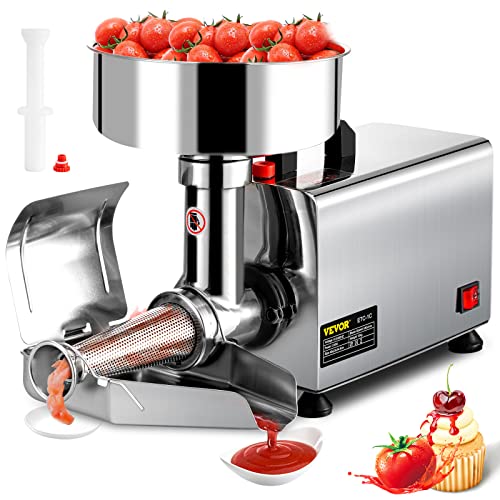
- 370W motor for production-focused processing
- 90–160 kg/hour listed processing range
- 304 stainless steel food-contact parts
Best For: High-volume tomato sauces, ketchup, and fruit jams
Best Large-Capacity Classic
Mirro 3.5-Quart Foley Food Mill

- 3.5-quart capacity for larger manual batches
- Handles mashing, straining, grating, and ricing
- Useful for applesauce, tomato sauce, and potatoes
Best For: Routine batch prep in small kitchens needing a manual mill
Best All-Rounder
Stainless Steel Food Mill with 3 Discs

- Three disc sizes for sauces, purées, and jams
- Stable dual-hook design with silicone grips
- Dishwasher-safe stainless steel construction
Best For: Small-batch, multipurpose food preparation
Best for High-Volume Sauce

- 450-watt motor with a large 9-inch hopper
- Stated throughput up to 352.74 pounds per hour
- Tool-free disassembly and stainless steel food-contact parts
Best For: Large-batch tomato sauce and fruit processing
Best for Canning Prep
Blue Stainless Steel Food Mill

- Three discs for sauces, potatoes, jams, and vegetables
- Includes funnel, measuring spoon, and multifunctional spoon
- Dishwasher-safe with hanging-hole storage design
Best For: Small-batch canning and versatile manual prep
Hand-Crank Versatility – Hungry Artisan 3-Disc Food Mill
For food mills for small businesses that need flexibility without relying on electricity, the Hungry Artisan offers a practical stainless steel setup for sauces, purees, and canning prep. Its three interchangeable discs let you adjust texture while the hand crank works anywhere.
Best For: Small businesses making applesauce, tomato sauce, baby food, purees, or jam bases in batches that need different textures.
Pros:
- Includes coarse, medium, and fine stainless steel discs.
- Separates skins, seeds, and cores while processing apples.
- Manual operation works without an outlet.
- Stainless steel body, discs, and crank are designed for repeated use.
Cons:
- Manual cranking requires more hands-on effort than an electric model.
- Its 2.8-pound design may be less suitable for very large commercial batches.
This is a well-rounded choice when texture control and portability matter more than maximum throughput. It suits small-batch production and seasonal canning work particularly well.
Stable Countertop Processing – OXO Good Grips Stainless Steel Food Mill
For food mills for small businesses focused on hot sauces and purees, the OXO Good Grips Food Mill combines a stainless steel bowl with a straightforward disc-change system. Its three folding, non-slip legs help it sit securely over suitable pots and bowls.
Best For: Small kitchens preparing hot purees, sauces, and other foods in batches of up to approximately 2.3 quarts.
Pros:
- Stainless steel bowl is suitable for hot foods and resists staining.
- Three discs support fine, medium, and coarse textures.
- Three non-slip legs fit over pots and bowls up to 11 inches in diameter.
- Folding legs support easier storage.
Cons:
- Its approximately 2.3-quart capacity limits larger production runs.
- Manual operation is slower and more labor-intensive than electric processing.
The OXO is a practical fit for businesses that value secure placement, manageable batch sizes, and easy texture changes. It is especially useful where storage space and hot-food handling are priorities.
High-Volume Electric Straining – Weston Deluxe Tomato Strainer
For food mills for small businesses processing harvests or bulk produce, the Weston Deluxe Electric Tomato Strainer is built for faster, larger-batch work. Its 250-watt motor, two speeds, and one-gallon hopper support sauces, purees, jellies, salsa, and preserving.
Best For: Small businesses processing tomatoes, soft fruits, and vegetables in larger batches for sauces, salsa, jams, or canning.
Pros:
- One-gallon hopper supports larger batches.
- 250-watt motor offers forward and reverse speeds to help prevent jamming.
- Includes 1.5mm, 3mm, and 6mm stainless steel screens.
- Separates skins and seeds without requiring coring.
Cons:
- Requires a 120-volt AC power source.
- Its 14-by-12-by-17-inch footprint needs dedicated counter or storage space.
- It is less portable than a manual food mill.
This model makes the most sense when throughput matters and an electrical outlet is available. The large hopper and varied screens give it a strong advantage for repeated preserving or sauce-making sessions.
Commercial-Style Manual Milling – Winco 9-Inch Stainless Steel Food Mill
For food mills for small businesses that need a straightforward manual tool, the Winco 9-inch Commercial Food Mill is designed around durable, corrosion-resistant construction and interchangeable plates. Its round format suits medium-sized batches of purees, sauces, soups, and general food preparation.
Best For: Professional kitchens handling medium-sized manual batches of purees, sauces, soups, and related food preparation.
Pros:
- Stainless steel construction is corrosion-resistant and durable.
- Interchangeable plates allow varied textures.
- Two-quart capacity suits medium-sized batches.
- Designed for easy cleanup and hygienic preparation.
Cons:
- Manual winding requires hands-on effort.
- The supplied details do not specify the number or sizes of interchangeable plates.
- Its 2-quart capacity may require multiple batches for higher-volume work.
The Winco is a sensible option for kitchens seeking a commercial-oriented manual mill without electric components. Its two-quart capacity keeps it suited to medium batches rather than continuous high-volume processing.
Best All-Around Manual Pick – Hungry Artisan 4-Disc Food Mill
For small businesses that need flexible batch prep without relying on electricity, the Hungry Artisan 4-Disc Food Mill offers four texture options for purees, sauces, jams, applesauce, and mashed potatoes. Its stainless steel construction, secure support hooks, and ergonomic crank make it a practical choice for repeated manual use.
Best For: Small-batch businesses making varied purees, sauces, preserves, and mashed products.
Pros:
- Four interchangeable stainless steel discs provide fine, coarse, and ultra-fine textures.
- Ergonomic silicone handle and spring-loaded crank help reduce hand fatigue.
- Double-welded hooks support the mill securely over bowls and pots.
- Dishwasher-safe, rust-resistant stainless steel simplifies cleanup and maintenance.
Cons:
- Manual operation may be slower for high-volume commercial production.
- Capacity and dimensions should be checked to ensure the mill fits the intended workflow.
This is a versatile food mill for small businesses that value texture control and portability over motorized throughput. It is especially well suited to seasonal preserving and varied made-to-order prep.
Best High-Volume Electric Option – VBENLEM 370W Tomato Strainer
For food mills for small businesses that prioritize speed, the VBENLEM electric tomato strainer uses a 370-watt pure copper motor and a large 9-inch funnel to process tomatoes and soft fruit into sauces. Its stainless steel food-contact parts and adjustable discharge trough support a more production-oriented setup.
Best For: Businesses processing tomatoes, ketchup, fruit sauces, and jams in larger batches.
Pros:
- Electric 370W motor is designed for substantially faster processing than a manual mill.
- Manufacturer lists a processing capacity of 90–160 kg per hour.
- Food-contact components are made from 304 stainless steel.
- Large funnel and adjustable trough help with feeding and sauce discharge.
Cons:
- It requires a 110V AC power source and is less portable than a manual mill.
- At 22 pounds and roughly 19.3 by 9.1 by 13.6 inches, it needs dedicated workspace.
- Its stated applications focus primarily on tomatoes, sauces, and jams rather than broad texture control.
This model is the strongest fit when throughput matters more than compact storage or manual flexibility. Confirm available power, workspace, and expected volumes before choosing it for a small commercial kitchen.
Best Large-Capacity Classic – Mirro 3.5-Quart Foley Food Mill
Mirro 50025 Foley Stainless Steel Healthy Food Mill Cookware, 3.5-Quart, Silver -
Check Price On AmazonThe Mirro Foley is a straightforward option for small businesses seeking a relatively large manual food mill for applesauce, tomato sauce, mashed potatoes, and other preparations. Its 3.5-quart capacity and stainless-finish construction make it useful for batch cooking, while its functions include mashing, straining, grating, and ricing.
Best For: Small kitchens that need a roomy manual mill for routine sauce, puree, and mash preparation.
Pros:
- 3.5-quart capacity accommodates larger manual batches.
- Supports mashing, straining, grating, and ricing tasks.
- Suitable for tomatoes, apples, potatoes, sauces, and purees.
- Stainless-finish design is intended for durability and easier cleaning.
Cons:
- Manual operation may not suit businesses requiring rapid continuous processing.
- The supplied details identify the material as plastic while also describing stainless finishes, so construction specifications should be verified.
The Mirro is a sensible capacity-first choice for businesses that want a traditional manual tool rather than an electric strainer. Its broad preparation range makes it more versatile than a tomato-only machine, provided its manual pace matches the workload.
Best All-Rounder – Stainless Steel Food Mill with 3 Discs
For small businesses looking for versatile food mills, this stainless steel hand-crank model offers three milling discs for sauces, mashed potatoes, jams, and other fruits and vegetables. Its dual-hook base, silicone-covered handle, and dishwasher-safe design support steady, repeatable prep without relying on electricity.
Best For: Small-batch sauce, purée, jam, and vegetable preparation where versatility and easy storage matter.
Pros:
- Food-grade stainless steel construction with a polished surface.
- Three disc sizes support different textures and help remove seeds.
- Dual hooks and silicone grips help keep the mill stable and comfortable to use.
- Can also function as a colander or vegetable steamer.
Cons:
- Manual operation requires hands-on effort for larger batches.
- The supplied details do not specify the bowl diameter or batch capacity.
This is a practical choice when your operation needs one adaptable mill for several foods rather than a dedicated high-volume machine. The included spoon is useful for pressing food through the screen and scraping the filter clean during prep.
Best for High-Volume Sauce – Electric Tomato Sauce Maker
For small businesses that process sauce ingredients in substantial quantities, this electric food mill provides a more production-oriented alternative to hand-crank models. Its 450-watt, 110-volt setup, 9-inch hopper, and stated throughput of 198.42–352.74 pounds per hour are designed for large tomato and fruit batches.
Best For: Commercial-style tomato sauce, fruit sauce, and jam production where speed and capacity are priorities.
Pros:
- 304 stainless steel food-contact parts resist rust and corrosion.
- Large hopper and motorized operation support high-volume processing.
- Tool-free disassembly simplifies cleanup between batches.
- Handles tomatoes, strawberries, blueberries, and other fruit.
Cons:
- At 21 pounds, it is substantially less portable than a manual mill.
- Requires a 110-volt electrical connection.
- The supplied manufacturer warranty is listed as three months.
This is the strongest fit for a small food business prioritizing throughput over compactness. The adjustable trough, included grinding rod, ventilation, and stated low-noise operation add useful workflow features, but its size and electrical requirements make it better suited to a dedicated prep area.
Best for Canning Prep – Blue Stainless Steel Food Mill
Businesses preparing tomato sauce, mashed potatoes, jams, or canned goods may appreciate this manual food mill’s flexible setup. It includes three milling discs, a stable dual-hook design, and additional utensils while remaining dishwasher-safe for simpler cleanup.
Best For: Small-batch canning and general-purpose sauce or purée preparation in a compact kitchen.
Pros:
- Three disc sizes accommodate different textures and ingredients.
- Stainless steel body is designed for repeated kitchen use.
- Dual hooks and silicone-covered grips help improve stability.
- Includes a multifunctional spoon, wide-mouth funnel, and measuring spoon.
Cons:
- Manual cranking may be tiring when processing larger quantities.
- The product details do not list a specific capacity or bowl-size requirement.
This model is a useful middle ground for small businesses that value flexibility and straightforward cleanup but do not need an electric machine. The funnel and measuring spoon are especially relevant to canning workflows, while the hanging hole can help save storage space.
How We Picked These Food Mills for Small Businesses
We focused on features that matter in a working kitchen rather than occasional home use: construction, capacity, disc versatility, processing speed, ease of cleaning, and suitability for repeated batches. The selection includes manual mills for lower-volume operations and electric tomato strainers for businesses that process substantial quantities of tomatoes or soft produce.
Because listed specifications can vary by seller and configuration, verify dimensions, power requirements, included screens, and replacement-part availability before ordering. Commercial-grade labeling is useful, but practical durability depends on materials, assembly, and how consistently the machine is cleaned and maintained.
Quick Comparison
- Manual stainless steel mills: Best for controlled, quieter processing and smaller batches of sauces, purées, potatoes, and jams.
- Three- or four-disc models: A flexible choice when your menu requires different textures, from coarse vegetable purée to smooth sauces.
- Electric tomato strainers: Better for frequent tomato processing, especially when reducing hand labor is a priority.
- High-throughput electric machines: Most appropriate for production-focused businesses with adequate counter space, power access, and storage.
Key Buying Factors for Food Mills for Small Businesses
Capacity and Throughput
Match the mill to your typical batch size, not an occasional peak order. A manual 2- to 4-quart-style mill may suit cafés, caterers, and specialty producers making modest batches. Electric models with large hoppers and stated hourly capacities make more sense for preserving, farm stands, and sauce businesses processing cases of tomatoes.
Disc Selection and Texture
Multiple discs let you adjust smoothness for tomato sauce, applesauce, baby-food-style purées, mashed vegetables, or jams. Confirm that the required discs are included and that replacements are available. A finer screen can improve texture, while a coarser screen may process fibrous ingredients more quickly.
Materials, Stability, and Cleanup
Stainless steel is generally preferable for frequent food contact because it is durable and easier to sanitize. Look for a stable support hook or legs that fit your pots, comfortable handles, and removable parts. Cleanup time matters: seeds, skins, and pulp can quickly make an inconvenient design costly to use.
Power and Workspace
Electric units may require a specific voltage and enough clearance for a hopper, chute, or waste container. Check whether the motor is suitable for your outlet and whether the machine can be stored safely between batches.
Who Should Buy Which Food Mills for Small Businesses?
Choose a manual multi-disc mill if you value low upfront cost, quiet operation, and control over small or medium batches. Choose a commercial stainless steel manual model for a busy kitchen that needs durable, straightforward equipment. Choose an electric tomato strainer if tomato processing is a regular production task and labor savings justify the added cost, noise, and maintenance. For the highest volumes, prioritize hopper size, stated capacity, motor support, and serviceable parts over compactness.