Electric food mills can turn cooked tomatoes, fruit, and vegetables into smooth sauces and purees with less manual pressing than a traditional hand mill. The right model can also reduce prep time during canning season or large-batch cooking.
This roundup compares 10 electric and motor-assisted options by power, capacity, materials, straining design, and intended workload so you can choose a practical fit for everyday meals or heavier production.
Best 10 Electric Food Mills Picks for 2026
Best Electric Mill for Large Batches

- 250-watt motor with forward and reverse speeds
- One-gallon hopper for batch processing
- Includes 1.5mm, 3mm, and 6mm screens
Best For: Large-batch sauces, purees, and canning
Best Manual Mill for Smooth Textures

- Three stainless steel discs for varied textures
- Non-slip legs fit bowls and pots up to 11 inches
- 2.3-quart stainless steel capacity
Best For: Everyday purees and sauces without electricity
Best High-Capacity Electric Mill
VEVOR 800W Max Tomato Strainer

- Up to 800W maximum power with 300W rated power
- Four screens from 1mm to 6mm
- 304 stainless steel parts and a guard cover
Best For: Continuous sauce making and harvest-season canning
Best Portable Manual Mill
Hungry Artisan 3-Disc Food Mill

- No outlet needed for hand-crank operation
- Three discs produce coarse, medium, or fine textures
- Stainless steel construction for repeated use
Best For: Portable applesauce, sauces, and small-batch purees
High-Volume Preserving
COSTWAY 450W Electric Tomato Strainer
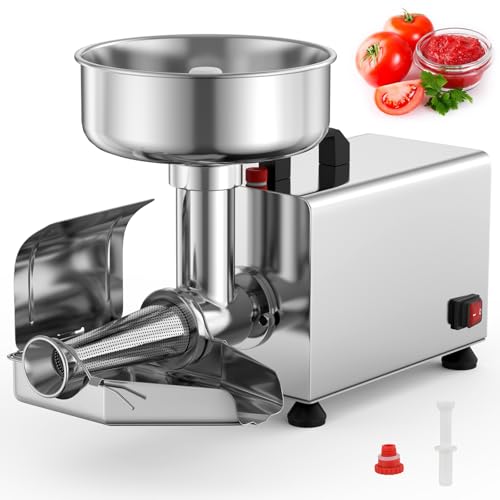
- Advertised 200–350 lb/h processing capacity
- 304 stainless-steel body and tool-free disassembly
- Safety pusher, guard, and anti-slip feet
Best For: Large-batch sauces, jams, and canning
Flexible Sauce Making
VEVOR Electric Tomato Strainer

- Four screens for different textures
- Separates peels and seeds in one pass
- Compact 7.2-pound stainless-steel design
Best For: Varied home sauces, purees, and jams
Multi-Function Kitchen Prep
AIRMSEN Meat Grinder & Tomato Press

- Tomato press, meat grinder, sausage, and kibbeh functions
- Three grinding plates plus a reverse function
- Detachable parts with hand-wash care
Best For: Multi-purpose home kitchen preparation
High-Volume Harvest Pick
VEVOR Electric Tomato Strainer

- 370W motor with up to 200 lb/H processing
- Stainless filter separates peels and seeds
- Tool-free disassembly for easier cleanup
Best For: Large-batch tomato sauce and canning
Quiet Stainless-Steel Workhorse

- 304 stainless food-contact components
- 9-inch hopper and adjustable trough
- Low-noise design with motor ventilation
Best For: High-capacity tomato sauce and fruit jams
Versatile Commercial-Style Option
VBENLEM Electric Tomato Strainer
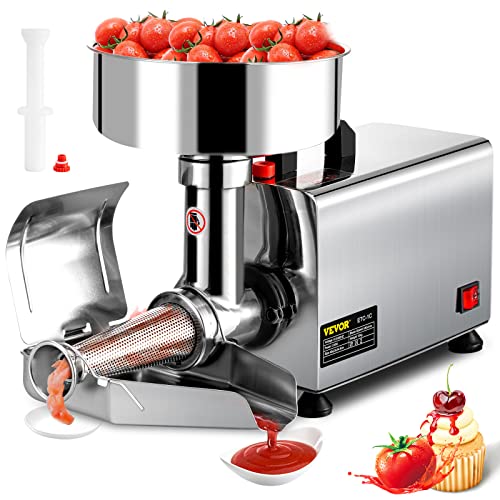
- 370W pure copper motor
- 9-inch funnel with adjustable trough
- Handles tomato and berry sauces
Best For: Versatile batch sauce and jam processing
Best Electric Mill for Large Batches – Weston Deluxe Tomato Strainer
For high-volume preserving, this electric food mill combines a 250-watt, two-speed motor with a one-gallon hopper. It separates skins and seeds from tomatoes and other soft produce for sauces, purees, jellies, and salsa.
Best For: Garden harvests, bulk produce, and home canning projects that require repeated straining.
Pros:
- Large one-gallon hopper supports sizable batches.
- Forward and reverse speeds help with processing and jam prevention.
- Three stainless steel screens cover fine, medium, and chunky textures.
- Includes a stomper for safely feeding produce.
Cons:
- Its 14-by-12-by-17-inch footprint requires substantial storage space.
- The electric design needs access to a 120-volt power source.
The Weston is a practical choice when throughput matters more than compact storage. Its screen selection also makes it adaptable for everything from smooth tomato sauce to chunkier salsa.
Best Manual Mill for Smooth Textures – OXO Good Grips Food Mill
This stainless steel food mill is a versatile manual option for hot foods, sauces, and purees. Its three grinding discs provide fine, medium, and coarse results, while the non-slip legs hold it over pots or bowls up to 11 inches wide.
Best For: Cooks who want a compact, outlet-free mill for preparing different puree textures.
Pros:
- Stainless steel bowl is suited to hot foods and resists staining.
- Three discs offer fine, medium, and coarse textures.
- Spring-loaded lever simplifies disc changes and disassembly.
- Non-slip folding legs support stable placement and easier storage.
Cons:
- Manual operation requires turning the handle by hand.
- The 2.3-quart capacity is smaller than the large electric models in this roundup.
The OXO is a well-rounded pick for everyday purees and sauces, especially when you value straightforward cleanup, stable placement, and flexible texture control over electric speed.
Best High-Capacity Electric Mill – VEVOR 800W Max Tomato Strainer
Among electric food mills, the VEVOR stands out for continuous sauce making and high-volume processing. Its motor delivers up to 800 watts maximum power, with a 300-watt rated power, while the stainless steel screen separates peels and seeds in a single pass.
Best For: Harvest-season canning and users who need multiple screen sizes for sauces, jams, purees, and salsa.
Pros:
- Designed for steady operation during large-batch sauce making.
- Includes four screens, from 1mm through 6mm, for different textures.
- 304 stainless steel components resist fruit acids and wear.
- Guard cover helps reduce splatter, and removable parts support cleaning.
Cons:
- At 7.2 pounds, it is less convenient to move than a compact manual mill.
- Its high-capacity design may be more machine than occasional users need.
The VEVOR is geared toward productivity and texture flexibility. The combination of continuous-duty positioning, four screens, and a splatter-reducing cover makes it especially suitable for preserving sessions.
Best Portable Manual Mill – Hungry Artisan 3-Disc Food Mill
The Hungry Artisan offers a simple, portable alternative to electric food mills. Its hand crank separates skins, seeds, and cores from foods such as apples and tomatoes, while three stainless steel discs let you choose a coarse, medium, or fine texture.
Best For: Outlet-free applesauce making, tomato sauce, canning, and small-batch purees.
Pros:
- Hand-crank operation works anywhere without an outlet.
- Three discs accommodate chunky through smooth preparations.
- Stainless steel body, discs, and crank are built for repeated use.
- Works with applesauce, tomato sauce, mashed potatoes, baby food, and jam bases.
Cons:
- Manual cranking is slower and more labor-intensive than electric models.
- Supplied notes do not specify a hopper or bowl capacity.
Choose the Hungry Artisan when portability and simplicity are priorities. It is particularly useful for cooks who want one durable hand tool for seasonal applesauce, sauces, and assorted purees.
High-Volume Preserving – COSTWAY 450W Electric Tomato Strainer
For large harvests and serious preserving, this COSTWAY model is one of the higher-capacity electric food mills in the roundup. Its 450W copper motor, large feed chute, and stainless-steel construction are designed for processing tomatoes and other fruits into smooth sauces, purees, and jams.
Best For: Large-batch tomato sauce, fruit preserves, and canning projects.
Pros:
- Advertised capacity of 200–350 pounds per hour.
- 304 stainless-steel construction with food-contact durability.
- Tool-free disassembly and dishwasher-safe detachable parts are designed to simplify cleanup.
- Safety pusher, enclosed motor guard, waterproof switch, and anti-slip feet support safer operation.
Cons:
- At 22 pounds and 20.5 inches deep, it requires substantial storage space.
- The supplied details list hand washing in the product-care instructions, despite noting dishwasher-safe detachable parts.
The COSTWAY is best suited to users who value throughput over compactness. Its capacity and sturdy build make it a compelling choice for harvest-season processing, while the larger footprint may be excessive for occasional small batches.
Flexible Sauce Making – VEVOR Electric Tomato Strainer
The VEVOR is a practical pick among electric food mills for shoppers who want several sauce textures from one machine. It separates peels and seeds in a single pass and includes four screens for adjusting the consistency of sauces, purees, jams, and salsa.
Best For: Home cooks making different sauces and purees with adjustable textures.
Pros:
- Includes 1mm, 1.5mm, 3mm, and 6mm screens for varied results.
- Stainless-steel filter separates skins and seeds to produce smoother preparations.
- 304 stainless-steel parts resist fruit acids and are removable without tools.
- Guard cover helps limit splatter, and the included cleaning brush supports rinsing.
Cons:
- The stated throughput is 88 pounds per hour, below the higher-capacity model in this roundup.
- The listing gives both an 800W maximum and a 300W rated-power figure, so electrical performance may require careful interpretation.
With a 7.2-pound weight and multiple screens, this VEVOR offers a more approachable balance of portability and versatility. It is a strong fit for varied home preserving, though high-volume users may prefer a machine with a greater stated capacity.
Multi-Function Kitchen Prep – AIRMSEN Meat Grinder & Tomato Press
The AIRMSEN expands beyond electric food mills by combining tomato pressing with meat grinding, sausage making, and kibbeh preparation. Its included tomato strainer kit makes it useful for sauce projects, while the separate grinding plates and attachments broaden its role in everyday kitchen prep.
Best For: Home cooks who want one appliance for tomato sauce and meat-based preparations.
Pros:
- Combines tomato straining, meat grinding, sausage making, and kibbeh preparation.
- Includes 5mm, 7mm, and 12mm grinding plates for different meat textures.
- Reverse function helps clear jams, while anti-slip feet and a safety lock support stable operation.
- All parts are detachable for cleaning and maintenance.
Cons:
- It is not dishwasher safe; hand washing is recommended.
- Its tomato-processing capacity and screen options are not specified in the supplied details.
- The product is listed with a 2500W peak motor but a 300W wattage detail, which may be confusing when comparing power ratings.
This AIRMSEN makes the most sense when versatility matters more than dedicated tomato-processing throughput. It can consolidate several kitchen tasks into one machine, but shoppers focused primarily on sauces may prefer a purpose-built strainer with clearer capacity specifications.
High-Volume Harvest Pick – VEVOR Electric Tomato Strainer
If you need electric food mills for processing garden tomatoes in sizable batches, this VEVOR model emphasizes throughput and straightforward cleanup. Its 370W motor, large hopper, and stainless-steel filter are designed for sauce, puree, and juice making, with a stated capacity of up to 200 pounds per hour.
Best For: Home canners and harvest-season cooks processing large tomato batches.
Pros:
- Stainless-steel screen separates peels and seeds in one pass.
- 370W motor and large hopper support high-volume processing.
- Core components disassemble without tools for quick rinsing.
- Stainless-steel hopper, tray, guard, and filter are suited to frequent use.
Cons:
- Tomatoes should be cut into small pieces to help reduce clogging.
- At 21.7 pounds, it is a substantial countertop appliance.
Its combination of batch capacity and removable stainless-steel parts makes it a practical choice when speed and repeatable sauce texture matter more than compact storage.
Quiet Stainless-Steel Workhorse – Electric Tomato Sauce Maker
Among electric food mills, this 110V sauce maker stands out for its full stainless-steel construction, wide hopper, and features intended for extended processing. It uses a 370W pure copper motor, an adjustable trough, and ventilation openings for making tomato sauce and fruit jams in larger batches.
Best For: Cooks who want a high-capacity stainless-steel mill for tomatoes and soft fruits.
Pros:
- Food-contact parts use 304 stainless steel for rust and corrosion resistance.
- Wide 9-inch hopper helps limit frequent refilling.
- Adjustable trough and brace guide sauce and help reduce splashing.
- Low-noise operation, level II waterproof rating, and ventilation support extended use.
Cons:
- The listed manufacturer warranty is only three months.
- Its 21-pound size may be less convenient for compact kitchens.
This model is a capable batch-processing option with thoughtful handling details, though buyers should weigh its larger footprint and short stated warranty before choosing it.
Versatile Commercial-Style Option – VBENLEM Electric Tomato Strainer
For shoppers comparing electric food mills for sauces and jams, the VBENLEM combines a 370W pure copper motor with a 9-inch feeding funnel and adjustable discharge trough. Its stainless-steel food-contact components are intended for processing tomatoes, strawberries, blueberries, and similar ingredients.
Best For: Users seeking a versatile mill for tomato sauce and multiple fruit-based preparations.
Pros:
- 370W pure copper motor supports sauce milling.
- 9-inch funnel provides a generous feeding area.
- Adjustable trough helps direct sauce and reduce splashing.
- Designed for low-noise operation and easy disassembly and cleaning.
Cons:
- The product is listed at about 22 pounds, so it is not especially lightweight.
- Its stated processing capacity is given as 90–160 kg/H, which may be more than occasional users need.
With its broad funnel, adjustable outlet, and support for both tomato and berry sauces, this is a sensible pick for varied batch processing when countertop space and weight are not major concerns.
How We Picked the Best Electric Food Mills
We focused on the features that most affect real-world milling: motor output, stated processing capacity, hopper size, food-contact materials, strainer design, cleanup, and ease of use. We also considered whether each machine is better suited to occasional home cooking, garden harvests, canning, or repeated high-volume batches.
Because manufacturer ratings are not always measured under identical conditions, throughput figures should be treated as useful estimates rather than direct performance comparisons. A machine’s results can vary with ingredient softness, preparation, moisture, and how frequently the hopper is fed.
Quick Comparison of Electric Food Mills
| Best For | What to Prioritize | Models in This Roundup |
|---|---|---|
| Small household batches | Compact design, simple controls, easy cleaning | OXO, Hungry Artisan |
| Tomato sauce and canning | Stainless construction, capable auger, efficient strainer | Weston, VEVOR, AIRMSEN |
| Large harvests | High stated capacity, large hopper, sturdy motor | COSTWAY, VBENLEM, 450W stainless models |
Key Buying Factors for Electric Food Mills
Motor Power and Throughput
Higher wattage can support tougher or longer processing, but wattage alone does not guarantee faster milling. Check the rated power, stated capacity, duty-cycle guidance, and whether the machine is intended for continuous use. For occasional sauce making, moderate power may be sufficient; large harvests benefit from a stronger motor and wider feed path.
Strainer and Food-Contact Materials
Stainless steel components are generally desirable for durability and resistance to staining. Confirm which parts contact food and whether the included screen is appropriate for seeds, skins, pulp, or softer fruit. A removable screen or interchangeable strainer can make the machine more versatile.
Hopper Size and Preparation
A larger hopper reduces refilling, but ingredients usually still need to be cooked, softened, trimmed, or cut to the manufacturer’s specifications. Do not assume an electric mill replaces all chopping or cooking steps.
Cleaning and Storage
Look for removable food-contact parts, accessible seams, and clear washing instructions. Some units are easier to rinse immediately than to deep-clean after pulp dries. Also measure your counter and storage space before choosing a commercial-style machine.
Safety and Electrical Fit
Verify voltage, grounding, switch placement, overload protection, and safe operating instructions. Never place motor components in water, and use the supplied tools rather than hands to move food toward the auger.
Who Should Buy Which Electric Food Mills?
Choose a compact or manual-style mill if you make occasional small batches and value straightforward cleanup over speed. A dedicated electric tomato strainer is a better match for gardeners and home canners processing repeated batches of cooked tomatoes. For frequent, high-volume work, prioritize commercial-grade stainless construction, a large hopper, durable auger components, and a clearly stated processing capacity.
If you prepare more than tomato sauce, select a model with suitable screens and manufacturer-approved uses for applesauce, fruit purees, or cooked vegetables. Buyers who want one appliance for several tasks should also check whether meat-grinding functions are genuinely needed, since added versatility can increase size, cleanup, and maintenance.