The best digital infrared thermometers make fast, contact-free temperature checks simple, whether you are monitoring a pizza oven, checking a grill, troubleshooting HVAC equipment, or handling home maintenance.
We compared these 10 options by temperature range, targeting accuracy, measurement distance, probe functionality, usability, and overall versatility to help you choose the right tool for your work.
Best 10 Digital Infrared Thermometers Picks for 2026
Best Overall

- -58°F to 842°F measurement range
- 12:1 distance-to-spot ratio
- Backlit display and included batteries
Best For: Versatile home, workshop, and outdoor surface checks
Best for HVAC Work
Klein Tools IR07 Dual IR and Probe

- Infrared and probe measurement modes
- 8:1 optical resolution
- Differential temperature calculation
Best For: HVAC vents, ducts, liquids, and service work
Best High-Temperature Range

- Measures up to 1,130°F
- Adjustable 0.1–1.0 emissivity
- Shows maximum surface temperature
Best For: High-heat cooking, automotive, HVAC, and workshop tasks
Best for Cooking
TempPro TempScan Infrared Thermometer
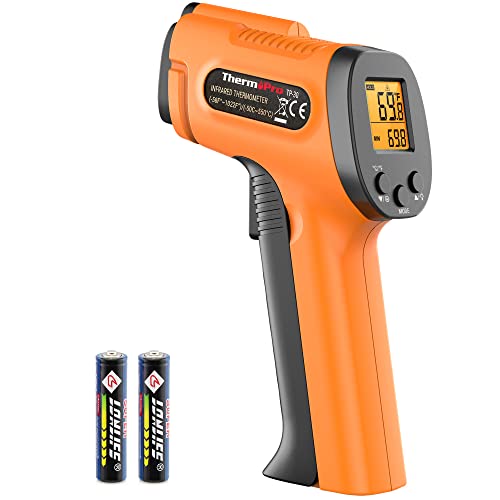
- Measures up to 1,022°F
- Under-500-ms response time
- MAX, MIN, and AVG scan readings
Best For: Pizza ovens, griddles, food preparation, and repairs
Best for High-Range Precision

- 20:1 distance-to-spot ratio
- -40°F to 1,200°F range
- Dual lasers and K-type probe support
Best For: Professional troubleshooting and demanding jobsite measurements
Best for Grilling Versatility

- Infrared gun plus meat probe
- Laser aiming and 0.5-second response
- Magnetic storage and adjustable emissivity
Best For: Cooking, grilling, and multipurpose household checks
Best for Simple Everyday Checks
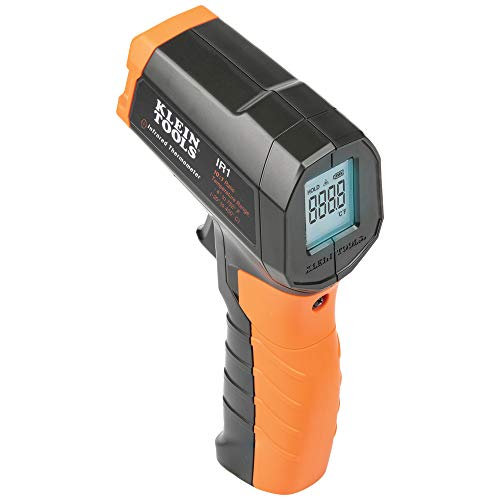
- 10:1 distance-to-spot ratio
- -4°F to 752°F measurement range
- Laser targeting and auto-hold
Best For: Routine indoor surface temperature checks
Best High-Range Pick
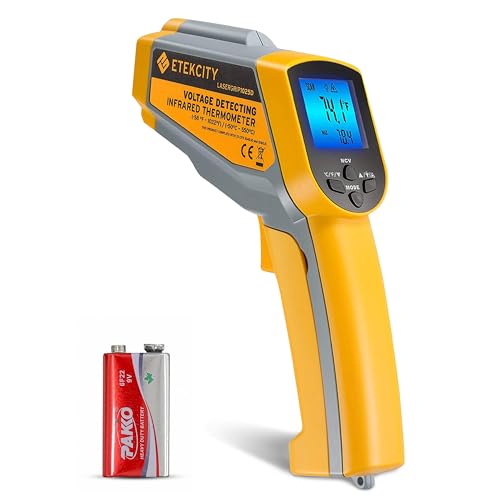
- -58°F to 1022°F measurement range
- Dual laser with 12:1 distance-to-spot ratio
- Adjustable emissivity and fast sub-500 ms response
Best For: High-temperature cooking, automotive, and HVAC tasks
Best Feature-Rich Professional Pick
Klein Tools IR5 Infrared Thermometer
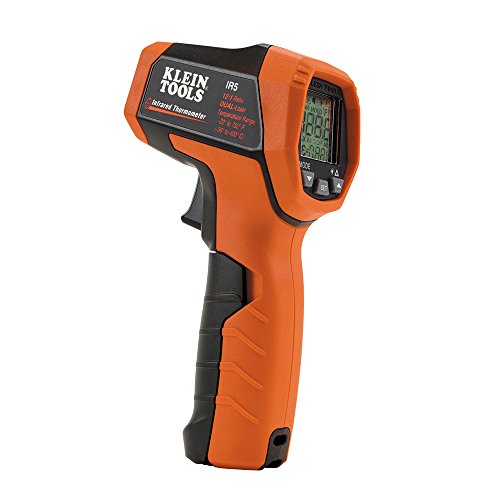
- -22°F to 752°F measurement range
- Dual targeting lasers with 12:1 optical resolution
- Min/max/average/difference modes and alarms
Best For: Maintenance and detailed surface-temperature checks
Best Budget Cooking Pick

- -58°F to 932°F measurement range
- Backlit display with data hold
- Two AAA batteries included
Best For: Grills, pizza ovens, and everyday cooking surfaces
Best Overall – Etekcity Lasergrip 774
The Etekcity Lasergrip 774 is a practical choice among digital infrared thermometers for quick, non-contact readings around the home, workshop, or outdoors. Its 12:1 distance-to-spot ratio, broad temperature range, and bright backlit display make everyday surface checks straightforward.
Best For: Home projects, cooking, HVAC checks, automotive work, and general-purpose temperature readings.
Pros:
- Measures from -58°F to 842°F (-50°C to 450°C).
- Fast readings appear in less than half a second.
- 12:1 distance-to-spot ratio supports measuring from a comfortable distance.
- Includes two AAA batteries and a backlit LCD display.
Cons:
- Designed for surface temperatures, not people or animals.
- Best results require positioning about 14.17 inches from the target.
With its simple trigger operation, auto-off feature, and useful 12:1 targeting ratio, the Lasergrip 774 is a well-rounded option for routine non-contact measurements.
Best for HVAC Work – Klein Tools IR07 Dual IR and Probe
Klein Tools IR07 Dual Infrared (IR) and Probe Thermometer | Pocket Size LCD Digital Thermometer
Check Price On AmazonThe Klein Tools IR07 stands out among digital infrared thermometers because it combines non-contact infrared scanning with a probe thermometer. That makes it useful when you need to check surface temperatures from a distance as well as air vents, ducts, or liquids directly.
Best For: HVAC troubleshooting, vent and duct checks, liquid temperatures, and users who need both IR and probe measurements.
Pros:
- Combines infrared measurement with a temperature probe.
- 8:1 optical resolution supports readings from a distance.
- Measures from -40°F to 752°F (-40°C to 400°C).
- Calculates differential temperature between IR and probe readings.
Cons:
- Indoor-use specification limits its intended environment.
- It is explicitly not intended for people or animals.
- Its 8:1 ratio offers less distance reach than some 12:1 models.
The IR07 is a specialized pick rather than a basic surface scanner. Its probe, hanging hook, differential calculation, pouch, and backlit LCD make it especially practical for service and HVAC tasks.
Best High-Temperature Range – Etekcity Lasergrip 1080
For applications that exceed the range of many digital infrared thermometers, the Etekcity Lasergrip 1080 offers measurements from -58°F to 1,130°F. Adjustable emissivity, maximum-temperature readout, and a 12:1 distance-to-spot ratio make it suited to demanding surface-temperature checks.
Best For: Heat guns, ovens, grills, automotive work, HVAC, and other high-temperature surfaces.
Pros:
- Extra-wide range from -58°F to 1,130°F (-50°C to 610°C).
- Adjustable emissivity from 0.1 to 1.0 for different surfaces.
- Displays maximum surface temperature and provides readings in 0.5 seconds.
- 12:1 distance-to-spot ratio supports safer distance measurement.
Cons:
- Emissivity adjustment requires additional setup for accurate readings across materials.
- The supplied details specify indoor use.
- It is intended for surfaces rather than body-temperature measurement.
The Lasergrip 1080 is the strongest fit when temperature range matters most. Its adjustable emissivity and high upper limit provide flexibility, while the laser targeting and backlit display keep operation convenient.
Best for Cooking – TempPro TempScan Infrared Thermometer
The TempPro TempScan is a cooking-friendly option among digital infrared thermometers, with a wide -58°F to 1,022°F range and quick readings for pizza ovens, griddles, and other surfaces. Adjustable emissivity helps tailor measurements to different materials, while MAX, MIN, and AVG memory adds useful context.
Best For: Pizza ovens, griddles, food preparation, home repairs, HVAC checks, and automotive maintenance.
Pros:
- Measures from -58°F to 1,022°F.
- Provides readings in under 500 milliseconds.
- Adjustable emissivity from 0.1 to 1.0 helps accommodate different surfaces.
- Displays maximum, minimum, and average temperatures from the last scan.
Cons:
- It measures surface temperature and should not replace a food-contact thermometer.
- Automatic shutoff after 90 seconds may interrupt extended checks.
- The supplied specifications list plastic construction and no carrying case.
With its fast response, high upper limit, and scan statistics, the TempScan is a useful choice for cooks and DIY users who want more than a single instant reading.
Best for High-Range Precision – Klein Tools IR10
For demanding digital infrared thermometers applications, the Klein Tools IR10 combines a 20:1 distance-to-spot ratio with a broad -40°F to 1,200°F measurement range. Dual targeting lasers, adjustable emissivity, and K-type probe support make it a flexible choice for detailed troubleshooting.
Best For: HVAC, electrical, mechanical, and jobsite temperature checks requiring long-distance accuracy and advanced measurement modes.
Pros:
- 20:1 optical resolution supports accurate readings from a distance.
- Measures from -40°F to 1,200°F and supports a K-type probe.
- Includes dual lasers, adjustable emissivity, alarms, and max/min/average/difference modes.
- IP54 protection and 9.8-foot drop protection improve jobsite durability.
Cons:
- More features than needed for simple temperature checks.
- Uses a 9V battery and is not intended for people or animals.
The IR10 is the strongest all-around option here for professionals who need broad temperature coverage, distance accuracy, and probe flexibility. Its extra controls add capability but may be unnecessary for occasional household use.
Best for Grilling Versatility – TempPro TempScan 2-in-1
The TempPro TempScan combines a laser-guided infrared thermometer with a digital meat probe, making it one of the most versatile digital infrared thermometers for cooking and household projects. It can check surface temperatures from a distance and internal food temperatures with the included probe.
Best For: Grilling, baking, frying, smoking, pizza stones, HVAC checks, and light DIY temperature measurements.
Pros:
- Combines non-contact infrared readings with a thermocouple food probe.
- Visible laser aiming, 12:1 distance-to-spot ratio, and 0.5-second response time simplify surface checks.
- Adjustable emissivity and MAX/MIN/AVG modes support varied surfaces.
- Magnetic back and hanging hole offer convenient storage.
Cons:
- Infrared measurement range is limited to -58°F to 1,022°F, while the food-focused range is -58°F to 572°F.
- Not suitable for measuring human body temperatures.
Choose the TempScan if you want one tool for grill surfaces and food interiors. Its dual-purpose design is especially practical in the kitchen or backyard, though dedicated professional instruments may offer more specialized features.
Best for Simple Everyday Checks – Klein Tools IR1
The Klein Tools IR1 is a straightforward choice among digital infrared thermometers, offering laser targeting, auto-hold, and a backlit display without a long list of advanced settings. Its 10:1 distance-to-spot ratio suits routine temperature checks across a -4°F to 752°F range.
Best For: Basic indoor maintenance, quick surface checks, and users who prefer a simple infrared thermometer.
Pros:
- 10:1 distance-to-spot ratio supports readings from a practical distance.
- Measures temperatures from -4°F to 752°F.
- Laser targeting, auto-hold, backlit display, and auto power-off are convenient for routine use.
- Includes a custom pouch and 9V battery.
Cons:
- Fixed 0.95 emissivity offers less flexibility across different surface materials.
- Lower temperature range and fewer features than the IR10.
- Not intended for people or animals.
The IR1 is a sensible pick when ease of use matters more than advanced customization. It handles common indoor measurements well, but users working with varied materials or extreme temperatures may benefit from a model with adjustable emissivity and a wider range.
Best High-Range Pick – Etekcity Lasergrip 1025D
The Etekcity Lasergrip 1025D is a versatile choice among digital infrared thermometers when you need a wide measurement range and adjustable settings. Its dual laser targeting, 12:1 distance-to-spot ratio, and fast response make it practical for grills, skillets, automotive work, and HVAC tasks. It is designed for inanimate surfaces, not people or animals.
Best For: High-temperature cooking, automotive maintenance, and HVAC measurements.
Pros:
- Measures from -58°F to 1022°F.
- Dual laser targeting and response time under 500 milliseconds.
- Adjustable emissivity from 0.1 to 1.0, with °F/°C selection and data-hold functions.
- Includes a 9V battery and a two-year warranty.
Cons:
- Not suitable for measuring human or animal temperatures.
- Best accuracy requires positioning about 14.17 inches from the target.
- Shiny or unusual surfaces may require emissivity adjustment.
With the broadest stated temperature range in this group and useful professional-style controls, the Lasergrip 1025D is a strong all-purpose surface thermometer for demanding household or trade applications.
Best Feature-Rich Professional Pick – Klein Tools IR5 Infrared Thermometer
The Klein Tools IR5 is one of the more feature-rich digital infrared thermometers for users who want targeting precision and multiple ways to interpret readings. Its 12:1 optical resolution, dual lasers, adjustable emissivity, and min/max/average/difference calculations suit maintenance and general surface-temperature checks. It is a non-medical device and should not be used on people or animals.
Best For: Maintenance, electrical or mechanical troubleshooting, and users who value calculation modes.
Pros:
- Measures from -22°F to 752°F.
- Dual laser targeting with a 12:1 distance-to-spot ratio.
- Includes auto scan, min/max/average/difference modes, and high/low alarms.
- Backlit display, adjustable emissivity, and automatic power-off.
Cons:
- Its upper temperature limit is lower than the Etekcity model’s.
- Listed response time is one second.
- Not intended for human or animal temperature readings.
The IR5 stands out when measurement analysis matters as much as the raw reading. It offers a useful balance of targeting accuracy and built-in comparison features, though its range is better suited to moderate-temperature applications than extreme heat.
Best Budget Cooking Pick – GM50 Infrared Thermometer
The GM50 is a straightforward option among digital infrared thermometers for cooking and outdoor tasks. It covers -58°F to 932°F, includes a backlit LCD, and holds the reading after the trigger is released. Its preset emissivity is convenient for many organic, painted, or oxidized surfaces, but shiny metal can produce inaccurate results unless prepared first.
Best For: Barbecue grills, pizza ovens, cooking surfaces, and basic outdoor temperature checks.
Pros:
- Measures from -58°F to 932°F with 0.1-degree resolution.
- Backlit LCD supports use in low-light conditions.
- Data-hold function and °F/°C selection are simple to operate.
- Includes two AAA batteries and automatic shutdown after about eight seconds.
Cons:
- Preset emissivity of 0.95 is not adjustable.
- Shiny or polished metal surfaces may give inaccurate readings without masking tape or flat black paint.
- Listed response time is 10 seconds.
For basic cooking measurements, the GM50 keeps the controls and setup simple while offering a high upper limit. Its fixed emissivity makes it less flexible than the other picks, so it is best used on suitable non-reflective surfaces.
How We Picked the Best Digital Infrared Thermometers
We focused on features that affect real-world results rather than choosing by temperature range alone. Each thermometer was considered for measurement accuracy, operating range, laser targeting, distance-to-spot ratio, response time, display readability, and ease of use. We also separated general-purpose infrared guns from models with useful extras, such as built-in meat probes or dual targeting lasers.
Application fit was another priority. A tool for checking a pizza stone may not be the best choice for electrical panels or HVAC vents, while a basic home model may be more convenient than a heavily featured professional instrument. The selections span cooking, grilling, workshop, automotive, and maintenance tasks.
Quick Comparison
- Best for general home use: Look for a clear backlit display, simple controls, and a broad temperature range.
- Best for cooking: Choose a model with a low-temperature range and, ideally, a probe for checking internal food temperature.
- Best for HVAC and electrical work: Prioritize a tighter distance-to-spot ratio, dual lasers, and a sturdy housing.
- Best for varied surfaces: Select adjustable emissivity if available, since shiny metal and reflective materials can produce misleading readings.
Key Buying Factors for Digital Infrared Thermometers
Temperature Range and Accuracy
Confirm that the thermometer covers your intended use. Most cooking tasks require moderate temperatures, while furnaces, engines, and industrial surfaces may need a much higher upper limit. Accuracy specifications matter most when you are comparing readings or working near a safety threshold.
Distance-To-Spot Ratio
A 20:1 ratio can measure a smaller area from farther away than a 12:1 or 8:1 model. This is useful for hot, moving, or difficult-to-reach surfaces. For close-range kitchen use, a lower ratio may be perfectly adequate.
Laser Targeting and Emissivity
Single lasers are usually sufficient for nearby surfaces. Dual lasers can make the measurement area easier to judge at greater distances. Adjustable emissivity is valuable when measuring metal, glass, or other reflective surfaces, but no infrared thermometer should be treated as equally reliable on every material.
Probe, Display, and Durability
A contact probe is especially helpful for checking the internal temperature of meat or liquids, while infrared measurement is better for pans, griddles, and oven surfaces. Also consider a backlit display, auto-hold, low-battery alerts, protective housing, and the available battery type.
Who Should Buy Which Digital Infrared Thermometers?
Home cooks and bakers should choose a simple, readable model with a suitable low-end range. Grill and barbecue users may benefit from a thermometer that combines infrared readings with a meat probe. Pizza oven owners should prioritize fast response and a wide upper range for measuring stones and cooking surfaces.
HVAC technicians, mechanics, and DIY users should look for a durable unit with a narrow measurement spot, strong targeting, and a wide operating range. If you routinely measure reflective metal, compare models for emissivity controls and verify readings with an appropriate contact instrument when precision is critical.