Finding the right corn grinder under $300 means balancing motor power, batch capacity, grind control, and cleanup. The models in this roundup cover compact kitchen-ready pulverizers, larger electric feed mills, and a durable manual option.
Use the comparison and buying advice below to match the grinder’s design and output with your intended workload, whether you are processing corn for flour, animal feed, or other dry grains.
Best 10 Corn Grinders Under 300 Picks for 2026
High-Speed Pick
750g Electric Grain Mill Grinder
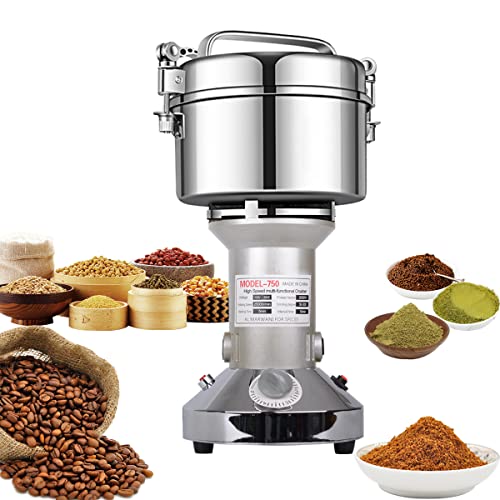
- 2,000W motor reaches up to 25,000 RPM
- 750g capacity for dry corn, grains, and spices
- Fine grinding with overload protection
Best For: Fast small-batch dry-ingredient grinding
Farm-Size Choice
Moongiantgo 25L Electric Corn Grinder

- 25-liter detachable bucket for larger batches
- Five sieves provide 2–8 mm output options
- 1,300W motor with simple start/stop controls
Best For: Household and farm feed grinding
Manual Budget Option

- No electricity and minimal heat buildup
- Adjustable disc controls grinding texture
- Cast-iron body with stable table clamp
Best For: Small batches and off-grid grinding
High-Throughput Pick

- 1,500W motor running at 1,400 RPM
- Approximately 70kg/hour stated grinding efficiency
- Large funnel and adjustable output thickness
Best For: Higher-volume dry grain processing
Best Large-Capacity Farm Grinder
6.6-Gallon Electric Corn Grinder

- 25-liter hopper for fewer refills
- Seven sieves for adjustable textures
- Designed for dry grain and livestock feed
Best For: Homesteads and small farms processing larger feed batches
Best Compact Pulverizer
VEVOR 1.8-Pound Stainless Steel Grinder

- 28,000-RPM motor for fast grinding
- Timed controls from 5 to 30 seconds
- Compact design for dry grains and spices
Best For: Small-batch kitchen, coffee, spice, and grain grinding
Best for Comfort
13.2-Gallon Electric Grain Grinder

- 50-liter capacity for larger batches
- Five sieves from 2 mm to 8 mm
- Stable tripod design with support legs
Best For: High-volume dry-grain and livestock-feed preparation
Fast Fine-Powder Pick

- 2,000W motor reaches 28,000 RPM
- Three-layer blades target superfine powder
- Safety shutoff and overload protection
Best For: Small batches of dry corn, grains, spices, and coffee
Heavy-Duty Adjustable Pick

- 3,000W motor for powerful dry grinding
- Cast-iron body and grinding plates
- Adjustable grind thickness control
Best For: Fixed-workspace grinding of corn and other dry crops
Large-Batch Feed Pick
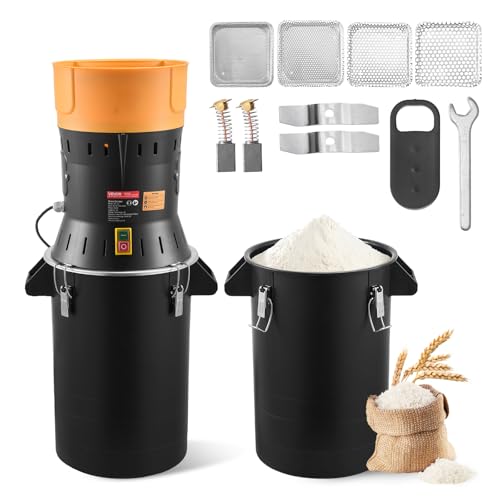
- 25-liter capacity for higher-volume work
- Five screens from 3 to 8 mm
- 600W motor with galvanized blades
Best For: Farm, ranch, and home dry-grain or feed grinding
High-Speed Pick – 750g Electric Grain Mill Grinder
If you need corn grinders under 300 for small-batch kitchen use, this compact electric mill offers high-speed pulverizing in a stainless steel container. Its 750g capacity and 2,000W motor suit dry corn, grains, spices, herbs, and coffee, though the timed operating cycle requires regular pauses.
Best For: Home cooks and small food-preparation spaces that need fine powder from dry ingredients.
Pros:
- 2,000W motor and up to 25,000 RPM for fast grinding.
- 750g capacity with reported fineness from 50 to 300 mesh.
- Stainless steel construction and overload shutoff with reset button.
- Works with dry corn, grains, spices, herbs, coffee, nuts, and rice.
Cons:
- Not suitable for wet, oily, or moisture-containing ingredients.
- Recommended operation is limited to three minutes, followed by a five-to-ten-minute rest.
- The motor area should be cleaned with a cloth rather than rinsed directly with water.
This is a speed-focused option for dry corn and other ingredients when fine results matter more than continuous operation. Follow the fill, cleaning, and cooldown instructions for more reliable use.
Farm-Size Choice – Moongiantgo 25L Electric Corn Grinder
For shoppers comparing corn grinders under 300 for household or farm tasks, this 1,300W electric mill stands out with a 25-liter, 6.6-gallon capacity. It is designed for dried corn, animal feed, grains, spices, and flour, with interchangeable sieves for different output sizes.
Best For: Farm households and users processing larger quantities of dried corn or feed.
Pros:
- Large 25-liter detachable bucket supports higher-volume grinding.
- Includes five sieves measuring 2, 3, 4, 6, and 8 mm.
- Simple green-button start and red-button stop controls.
- Hopper and bucket detach for water-based cleaning, while the motor stays dry.
Cons:
- Designed for dried ingredients, so it is not a wet-grinding machine.
- The larger bucket and hopper require more storage space than compact mills.
- Output texture depends on changing and selecting the appropriate sieve.
With its feed-friendly capacity, continuous material feeding, and included sieves, this is the most practical choice here for recurring farm or household batches. The one-year warranty and free parts replacement add useful ownership support.
Manual Budget Option – VEVOR Hand-Crank Corn Grinder
If you prefer a non-electric solution among corn grinders under 300, this VEVOR hand-crank mill uses a cast-iron body and table clamp for steady manual grinding. It handles corn, grains, spices, nuts, and coffee without electricity, making it useful for small batches and situations where heat buildup is a concern.
Best For: Small-batch users who want manual control, portability, and no dependence on an electrical outlet.
Pros:
- Manual operation avoids electricity use and helps limit heat buildup.
- Adjustable grinding disc lets you control texture from coarse to finer results.
- Table clamp fits surfaces with openings from 0.79 to 1.58 inches.
- Powder-coated cast iron is designed for durability and rust resistance.
Cons:
- Manual cranking requires more time and physical effort than electric models.
- Low hopper capacity is better suited to small batches.
- Finer results may require multiple passes.
This mill is a sensible fit when quiet, electricity-free operation and ingredient control are priorities. Its clamp and dust cover improve stability and cleanliness, while the manual design naturally limits throughput.
High-Throughput Pick – 1500W Electric Corn Grinder
For buyers seeking corn grinders under 300 with a more traditional mill format, this 1,500W electric model combines a large stainless steel funnel with a precision cast-steel grinding assembly. Its 1,400 RPM motor is listed at approximately 70kg per hour, and the front adjustment knob allows the output thickness to be fine-tuned.
Best For: Restaurants, supermarkets, and other settings that need higher-volume dry grain processing.
Pros:
- 1,500W motor and approximately 70kg-per-hour stated efficiency.
- Large stainless steel funnel supports feeding larger quantities.
- Front knob adjusts the grinding thickness.
- Rubber feet and a support frame help maintain stability during operation.
Cons:
- The larger frame requires substantial storage space.
- Its design is better suited to higher-volume use than compact countertop batches.
- The supplied notes focus on dry grains and do not indicate wet-grinding capability.
This model is the strongest match for throughput-focused buyers who have room for a larger mill. Its cooling holes, sturdy metal construction, adjustable output, and large funnel support extended practical use with dry corn and grains.
Best Large-Capacity Farm Grinder – 6.6-Gallon Electric Corn Grinder
If you need corn grinders under 300 for regular feed preparation, this 6.6-gallon electric model is built around capacity and flexibility. Its 25-liter hopper, 1,500-watt motor, and seven interchangeable sieves suit homesteads and small farms processing dry corn, wheat, rice, and other grains.
Best For: Homesteaders and small farms making customized poultry or livestock feed in larger batches.
Pros:
- Large 6.6-gallon hopper reduces the need for frequent refilling.
- Seven sieves allow different grinding textures for feed, flour, or spices.
- Handles a broad range of dry grains, including corn, wheat, rice, barley, and soybeans.
- Includes a handle for easier transport and lists a three-year manufacturer warranty.
Cons:
- Its 230-volt specification may not suit every household electrical setup.
- Designed for dry materials only, and the screen must be changed only after unplugging the mill.
This is a practical choice when batch size and adjustable texture matter more than compact storage. Verify your available voltage before buying.
Best Compact Pulverizer – VEVOR 1.8-Pound Stainless Steel Grinder
Among corn grinders under 300, this compact VEVOR model favors fine, fast grinding over high-volume feed production. The 2,100-watt motor reaches 28,000 RPM, while timed settings and a stainless-steel body make it suited to dry corn, grains, coffee, and spices in kitchen or small-workspace use.
Best For: Users who want a compact grinder for small batches of dry grains, spices, cereals, or coffee.
Pros:
- High-speed motor can turn suitable dry ingredients into fine powder quickly.
- Five-, 15-, and 30-second timer options simplify repeatable grinding.
- Stainless-steel housing and triple blades support a fine, even grind.
- Compact 1.8-pound capacity and wipe-clean design suit countertop use.
Cons:
- Its smaller capacity is less appropriate for large livestock-feed batches.
- Not intended for wet, oily, or sticky materials.
- Continuous operation is limited to five minutes followed by a five- to ten-minute rest.
This model makes the most sense when you value speed, fine powder, and a smaller footprint. It is a better fit for dry kitchen ingredients than continuous farm-scale milling.
Best for Comfort – 13.2-Gallon Electric Grain Grinder
For shoppers comparing corn grinders under 300 with an emphasis on throughput, this 1,300-watt grinder offers a large 50-liter capacity and continuous feeding. Its copper-core motor, support legs, and five included sieves make it suitable for dry corn, grains, spices, and animal-feed preparation at home or on a small farm.
Best For: High-volume dry-grain and livestock-feed grinding where a large hopper and steady operation are priorities.
Pros:
- Large 50-liter capacity and continuous-feed design support productive batch work.
- Five sieves provide 2 mm, 3 mm, 4 mm, 6 mm, and 8 mm grinding options.
- Copper-core motor is designed for efficient heat dissipation.
- Tripod support legs with foot sleeves help reduce vibration and tipping.
Cons:
- Its 41.7-inch height and industrial-style structure require substantial storage space.
- For dry materials only; the large capacity may be excessive for occasional kitchen use.
This grinder stands out for users who need sustained productivity and multiple texture choices. Consider its tall profile and large footprint before placing it in a home workspace.
Fast Fine-Powder Pick – 550g High-Speed Grain Mill
If you want one of the more compact corn grinders under 300 for quick, fine results, this VEVOR model uses a 2,000W motor and three-layer blade system. It can process dry corn and other grains into a superfine powder, but its short duty cycle makes it better suited to batches rather than continuous operation.
Best For: Home kitchens, small batch grain grinding, and users who want a fine powder from dry corn, cereals, spices, or coffee.
Pros:
- High-speed 28,000 RPM motor and three-layer blade design can grind dry ingredients in about 30 seconds.
- Stainless-steel construction and a sealed buckle-style lid support durable, contained operation.
- Built-in lid shutoff, overload protection, timer, and included sieve add convenience and safety.
- Handles a wide range of dry grains, including corn, wheat, oats, barley, and soybeans.
Cons:
- Operation is limited to five minutes, followed by a recommended five- to 10-minute rest.
- It is not suitable for wet, fresh, oily, or sticky ingredients.
- The 550g capacity may require multiple batches for larger quantities.
This is a practical choice when fine texture and countertop versatility matter more than nonstop throughput. Follow the dry-material and cleaning instructions, and use the included sieve for an additional pass when needed.
Heavy-Duty Adjustable Pick – 3000W Commercial Corn Mill
For shoppers comparing corn grinders under 300 with an emphasis on heavy-duty construction and adjustable texture, this VEVOR electric mill uses cast-iron grinding plates and a 3,000W motor. Its funnel feed supports steady loading, while the adjustment control lets you vary the grind for corn, wheat, rice, cereals, and other dry crops.
Best For: Users needing a sturdy, industrial-style mill for adjustable dry grinding of corn and other grains.
Pros:
- 3,000W motor is designed for powerful, continuous dry grinding.
- Cast-iron body and grinding plates provide a substantial, durable build.
- Adjustable thickness control supports different textures for corn, spices, coffee, cereals, wheat, and nuts.
- Funnel-shaped feed design helps maintain a consistent feeding speed.
Cons:
- At 46.7 pounds, it is considerably less portable than compact countertop grinders.
- The 500g stated capacity may limit each individual batch despite its industrial styling.
- Its 28.15-inch height requires more dedicated storage or operating space.
This model makes the most sense when durability and grind adjustment are priorities. Its large, heavy form factor is better suited to a fixed workspace than occasional portable use.
Large-Batch Feed Pick – 25L Screened Grain Grinder
This VEVOR mill is a useful option among corn grinders under 300 when you need a larger hopper and selectable screen sizes. Its 25-liter capacity, 600W motor, and galvanized blades are designed for dry corn, grains, spices, and feed, with interchangeable screens for controlling coarseness.
Best For: Ranch, farm, and home users processing larger quantities of dry corn, grain, flour, or feed with different texture requirements.
Pros:
- 25-liter capacity supports larger-volume processing than compact spice-style grinders.
- Five included screen sizes—3, 4, 5, 6, and 8 mm—provide flexible coarseness control.
- 15,000 RPM motor and galvanized blades are designed for efficient, stable grinding.
- Detachable hopper and feed inlet simplify cleaning while keeping water away from the motor.
Cons:
- The 32.09-inch height may be inconvenient for low counters or limited storage areas.
- It is intended for dry materials and is not presented as a wet-grinding machine.
- Its 600W motor is less powerful on paper than the other listed VEVOR models.
Choose this grinder when capacity and screen-based texture control are more important than a compact footprint. The removable feed components also make routine cleaning more manageable for repeated use.
How We Picked the Best Corn Grinders Under 300
We focused on the factors that matter most at this price: motor power, hopper or chamber capacity, construction, grind flexibility, operating style, and suitability for different workloads. The selection includes high-speed stainless-steel pulverizers for dry grains and spices, larger electric mills designed for feed processing, and a hand-crank cast-iron grinder for users who prefer a manual setup.
Because product specifications can vary by seller and configuration, confirm voltage, included screens or sieves, capacity, and safety instructions before ordering. High wattage does not automatically mean a grinder is best for every task; duty cycle, feed rate, and cleanup can matter just as much.
Quick Comparison
| Type | Best For | Main Advantage | Potential Trade-Off |
|---|---|---|---|
| Compact electric pulverizer | Home flour, spices, and small batches | Fast grinding and relatively small footprint | Limited batch size and possible heat buildup |
| Large electric feed mill | Chicken feed and frequent grain processing | Higher capacity and multiple sieves | More storage space and louder operation |
| Manual cast-iron mill | Off-grid or occasional grinding | No electricity required and sturdy construction | Slower, more labor-intensive output |
Key Buying Factors for Corn Grinders Under $300
Power and Intended Workload
Models rated from roughly 600W to 750W can suit lighter household work, while 1,300W to 3,000W machines are aimed at faster or heavier processing. Consider how much corn you grind per session rather than choosing the highest advertised wattage. Commercial-style units may also require short rest periods to prevent overheating.
Capacity and Feeding Design
A small grinding chamber is easier to handle and clean, but it requires more frequent refilling. Large 6.6-gallon or 13.2-gallon designs are more practical for feed preparation and repeated batches. Check whether the listed capacity refers to the hopper, collection container, or maximum safe load.
Grind Adjustment and Included Sieves
Interchangeable screens or sieves provide more control over flour, meal, and coarse feed texture. Adjustable models are useful when one machine must handle several grains. Confirm that replacement screens are available if you expect regular use.
Construction, Safety, and Cleanup
Stainless-steel bodies resist corrosion and are generally easier to wipe clean, while cast iron offers a traditional, durable manual design. Look for stable clamps or feet, secure lids, overload protection, and clear instructions. Never grind wet ingredients in a machine designed only for dry grains, and unplug the unit before cleaning.
Who Should Buy Which Corn Grinders Under 300?
Choose a compact electric pulverizer if you mainly need corn flour, meal, or dry spices in modest quantities. Select a larger electric feed grinder if you prepare chicken or livestock feed regularly and value capacity and multiple sieve options. A high-powered commercial-style grinder makes more sense for frequent, demanding batches, provided you have adequate ventilation, counter space, and electrical capacity. Choose the VEVOR manual mill if electricity-free operation, long-term simplicity, or occasional use matters more than speed.
Before buying, match the grinder to your available power outlet, storage space, expected batch size, and desired texture. That approach will usually produce better results than comparing motor wattage alone.