Choosing the right corn grinder can affect production speed, grind consistency, labor costs, and daily operating reliability. Small businesses need a machine that matches their batch size without paying for capacity they will not use.
This roundup compares 10 selected grinders, from high-powered electric pulverizers to durable manual cast-iron mills, with attention to capacity, controls, construction, and practical operating needs.
Best 10 Corn Grinders for Small Businesses Picks for 2026
Heavy-Duty Electric Pick

- Powerful 3000W motor for continuous grinding
- Adjustable thickness for different textures
- Cast iron construction with stainless steel funnel
Best For: Small businesses needing powerful, adjustable dry grinding
Manual Workhorse
Victoria 2400g Cast Iron Grain Mill

- Manual design needs no electricity
- Adjustable screw controls grind coarseness
- High hopper holds up to 2400 g
Best For: Small-batch makers wanting a sturdy manual corn mill
High-Throughput Option
NAIZEA 3000W Electric Grain Mill
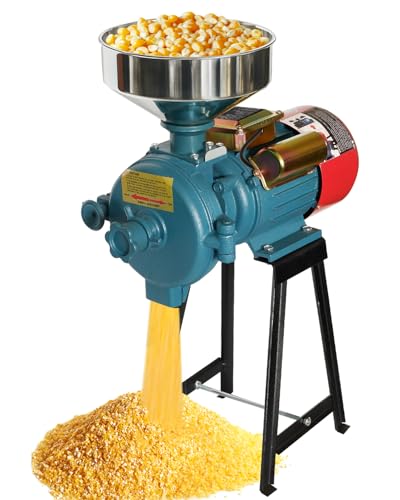
- 3000W motor with listed 1400–2800 RPM range
- Supports dry, wet, and feed grinding
- Published corn rate of up to 60 kg/h
Best For: Food-processing or feed businesses needing versatile electric grinding
Traditional Specialty Pick
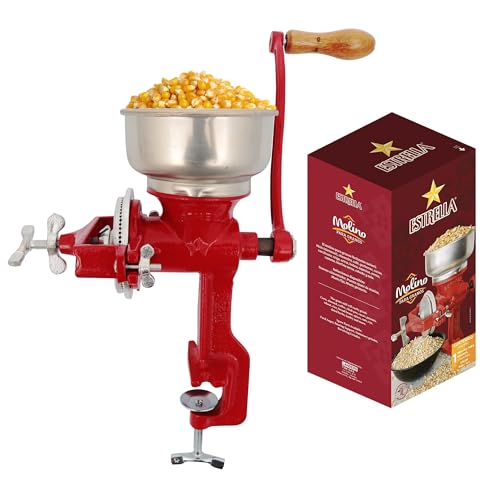
- Made for masa, nixtamal, and traditional recipes
- Adjustable cast iron hand-crank design
- Clamps to countertops up to 1.5 inches
Best For: Specialty food makers preparing fresh masa and corn products
Fast Fine-Powder Pick

- 2,000W motor reaches 28,000 RPM
- 30–300 mesh grinding range
- Safety shutoff and overload protection
Best For: Small-batch fine corn, grain, spice, and coffee processing
High-Output Workhorse

- Rated up to 133 lb/h for corn
- Adjustable texture from coarse to fine
- Large funnel with flow limiter
Best For: Higher-volume dry grain and feed processing
Compact Batch Choice

- 1.8 lb cup with 270° shaking action
- 2,100W, 28,000 RPM motor
- 5-, 15-, and 30-second timer settings
Best For: Compact, timed batches of dry corn, grains, spices, and coffee
Best Flexible Feed Mill

- 25-liter capacity for dry grains and feed
- Five interchangeable sieves from 2–8 mm
- Detachable, portable design for easier cleaning
Best For: Small farms and home-based milling
Best High-Speed Pulverizer

- 2500-gram capacity with 32,000 RPM operation
- Adjustable 30–300 mesh fineness and timer settings
- Stainless steel blades and overload protection
Best For: Dry-ingredient food businesses needing fine powders
Best Heavy-Duty Capacity

- Rated capacity of up to 200 pounds per hour
- Adjustable grinding from coarse meal to fine powder
- Rust-resistant galvanized cast iron housing
Best For: Small farms and higher-volume dry-grain processing
Heavy-Duty Electric Pick – 3000W Commercial Corn Mill
For small businesses needing high-output corn grinders for small businesses, the VEVOR Electric Grain Mill combines a 3000W motor with adjustable grinding thickness. Its cast iron construction and 500 g capacity suit dry grinding of corn, wheat, rice, sorghum, soybeans, spices, and other crops.
Best For: Small food businesses that need powerful, adjustable dry grinding and can accommodate a large 46.7-pound machine.
Pros:
- Powerful 3000W motor supports continuous, high-speed grinding.
- Adjustable setting lets you control the grind thickness.
- Durable cast iron body and grinding plates are designed for prolonged use.
- Funnel-shaped stainless steel hopper promotes consistent feeding.
Cons:
- At 46.7 pounds, it is not especially portable.
- The listed 500 g capacity may require frequent refilling for larger batches.
- Designed for dry grinding rather than wet processing.
This is the strongest fit here for businesses prioritizing motor power and repeatable dry processing. Confirm that its footprint, electrical requirements, and batch capacity match your workspace and workflow.
Manual Workhorse – Victoria 2400g Cast Iron Grain Mill
The Victoria Manual Cast Iron Grain Mill is a practical option for small businesses that value low-tech operation and do not need electric throughput. Its high hopper, adjustable screw, and table clamp support manual grinding of corn and other grains, while the compact 4.4-pound design is easier to move than electric models.
Best For: Small-batch makers, home brewers, and food vendors who want a manually powered corn mill for coarse-to-fine grinding.
Pros:
- Heavy-duty cast iron construction with double tin plating.
- Adjustable screw changes the coarseness or fineness of the grind.
- High hopper has a listed 2400 g capacity.
- Clamps to tables from 1/2 to 2 inches thick and includes a non-slip protector.
Cons:
- Manual cranking is less suitable for high-volume production.
- It cannot produce a superfine texture.
- It will not grind whole wheat into a fine powder.
Choose this Victoria mill when simplicity, portability, and hands-on control matter more than speed. Its stated limitations make it better for specialty or small-batch work than continuous commercial processing.
High-Throughput Option – NAIZEA 3000W Electric Grain Mill
The NAIZEA Electric Grain Mill is aimed at commercial and small-business use, pairing a 3000W, 110V motor with stated processing rates for corn, rice, wheat, and paddy rice. It also supports wet grinding and feed crushing, giving businesses more flexibility than a dry-only corn grinder.
Best For: Small food-processing operations, farms, or feed businesses that need electric grinding with published throughput figures and wet/dry versatility.
Pros:
- 3000W motor operates at a listed 1400–2800 RPM range.
- Handles dry grains, soaked soybeans or rice, and animal feed.
- Published rates include up to 60 kg/h for corn and 75 kg/h for rice or wheat.
- Corrosion-resistant galvanized cast iron shell is designed for long-term use.
Cons:
- The 50 kg listed weight makes it difficult to reposition.
- Its large commercial footprint may not suit very small workspaces.
- Throughput can vary by ingredient and processing mode.
Among these corn grinders for small businesses, the NAIZEA stands out for versatility and explicitly listed capacity figures. It is worth considering when wet processing or feed crushing is part of the workflow, not just corn milling.
Traditional Specialty Pick – Estrella Manual Corn Grinder
The Estrella Manual Grain Mill is a traditional hand-crank molino designed for fresh corn, nixtamal, masa, and other coarse ingredients. For small businesses producing tortillas, tamales, pupusas, arepas, or similar foods, its countertop clamp and removable parts offer a straightforward setup and cleanup routine.
Best For: Specialty food makers and small kitchens seeking traditional, manual preparation of masa and freshly ground ingredients.
Pros:
- Designed specifically for traditional corn and nixtamal preparation.
- Cast iron construction supports long-term manual use.
- Adjustable grinding settings handle corn, chickpeas, wheat, rice, coffee, spices, and more.
- Clamps to countertops up to 1.5 inches thick and has removable parts for cleaning.
Cons:
- Manual operation is slower and more labor-intensive than electric milling.
- Its countertop clamp limits placement to suitable surfaces.
- The supplied notes do not specify a batch capacity or commercial throughput.
This Estrella is best viewed as a compact specialty tool rather than a high-volume production mill. It makes sense for businesses where traditional texture, fresh preparation, and recipe-focused flexibility are more important than speed.
Fast Fine-Powder Pick – 750g High-Speed Grain Grinder
For small businesses needing compact corn grinders for small businesses, this 2,000-watt VEVOR model is designed for fast, fine dry-material processing. Its 750g capacity, 28,000 RPM motor, and included sieve make it useful when corn, grains, spices, or coffee need to be pulverized into a fine powder.
Best For: Small-batch businesses, kitchens, and processing applications that prioritize superfine results over continuous operation.
Pros:
- Grinds dry ingredients to a stated 30–300 mesh fineness.
- Three-layer blade design supports fast, even pulverizing.
- Stainless-steel construction, overload protection, and lid safety shutoff add practical durability and safety.
- Includes a sieve for separating and reprocessing coarse particles.
Cons:
- Operation is limited to five minutes before a required five- to ten-minute rest.
- Only suitable for dry materials; wet, oily, and sticky ingredients are excluded.
- Cleaning requires a dry cloth or brush rather than direct water washing.
This is a strong fit for businesses producing fine corn flour or powdered ingredients in short batches. Its compact footprint is convenient, but the duty cycle makes it less suitable for uninterrupted high-volume production.
High-Output Workhorse – 3000W Adjustable Corn Grinder
For small businesses that need higher throughput, this 3,000-watt electric mill is one of the more production-oriented corn grinders for small businesses. It is rated for up to 133 pounds per hour of corn and includes an adjustable funnel flow limiter to help manage feeding during dry grain processing.
Best For: Farms, feed operations, and small commercial setups processing large batches of dry corn, wheat, rice, or similar materials.
Pros:
- High-powered motor is rated for 133 pounds per hour of corn and 166 pounds per hour of wheat.
- Thickness adjustment supports coarse meal through finer powder.
- Large funnel and flow limiter help control feeding and reduce clogging or overloading.
- Galvanized cast-iron construction is designed for frequent use and rust resistance.
Cons:
- Its 20-by-10.5-by-30-inch size requires more dedicated space.
- Strictly intended for dry materials; wet-grinding accessories are sold separately.
- Regular bolt tightening is recommended for long-term stable operation.
This model makes the most sense when output and adjustable texture matter more than compactness. The substantial construction and large funnel favor a permanent workstation rather than occasional countertop use.
Compact Batch Choice – 1.8 lb Swing-Type Pulverizer
Businesses looking for compact corn grinders for small businesses may prefer this 2,100-watt swing-type VEVOR grinder. Its 1.8-pound cup, 270-degree shaking design, timed controls, and three stainless-steel blades are suited to quick batches of dry corn, grains, spices, or coffee.
Best For: Small commercial kitchens, labs, and businesses that need flexible, fine grinding in modest batches.
Pros:
- 1.8-pound capacity is larger than a typical small kitchen grinder while remaining compact.
- 28,000 RPM motor and triple blades are designed to produce fine, even powder.
- 5-, 15-, and 30-second timing options simplify repeatable batch processing.
- Included sieve and brush-friendly cleaning make post-processing practical.
Cons:
- Continuous operation is limited to five minutes followed by a five- to ten-minute rest.
- Not designed for wet, oily, or sticky ingredients.
- Hard ingredients may need to be cut into smaller pieces first.
This grinder balances capacity and footprint well for businesses working in short, repeatable batches. Its timer choices and swing action add convenience, though the required rest periods limit sustained production.
Best Flexible Feed Mill – Portable 1000W Corn Grinder
For small businesses that need a practical option among corn grinders for small businesses, this 1000-watt mill offers a useful balance of capacity, portability, and grind-size flexibility. Its 25-liter capacity and interchangeable sieves make it suitable for processing dry corn, grains, spices, and feed in smaller operations.
Best For: Small farms, home-based milling, and businesses needing multiple grind sizes for dry ingredients or animal feed.
Pros:
- Includes five sieves for 2, 3, 4, 6, and 8 mm grind sizes.
- 25-liter capacity supports household or farm feed preparation.
- Detachable hopper and bucket make storage and cleaning easier.
- Simple start and stop buttons with a portable design.
Cons:
- Designed for dry materials; water must be kept away from the motor.
- Its 1000-watt motor is less powerful than the larger commercial-style models in this roundup.
This is a sensible choice when flexibility and easy handling matter more than maximum throughput. The included sieves are particularly useful for small businesses serving varied feed or milling needs.
Best High-Speed Pulverizer – 3400W Swing-Type Corn Grinder
Businesses seeking high-speed corn grinders for small businesses may prefer this stainless steel pulverizer. Its 3400-watt motor, 2500-gram capacity, and 32,000 RPM operating speed are geared toward turning dry corn, grains, spices, coffee beans, and nuts into fine powder quickly.
Best For: Small food businesses that need fine, uniform powders from dry grains, spices, coffee beans, or similar ingredients.
Pros:
- Processes up to 2500 grams, with grinding in as little as 30 seconds.
- Three-layer stainless steel blades support finer, more even results.
- 270-degree swing design helps reduce sticking and makes pouring easier.
- Offers timer settings, adjustable 30–300 mesh fineness, overload protection, and lid-open auto-stop.
Cons:
- Not suitable for wet, fresh, oily, or sticky materials.
- Requires rest periods after up to five minutes of continuous work.
- The body and components should be cleaned with a damp cloth rather than rinsed directly.
This model is best suited to dry-ingredient operations where speed and fine powder production are priorities. Its safety features and adjustable fineness add useful control, but material restrictions and cleaning requirements should fit the workflow.
Best Heavy-Duty Capacity – 3000W Commercial Corn Grinder
For small businesses and farms comparing corn grinders for small businesses, this 3000-watt industrial-style mill emphasizes throughput and adjustable grinding. The manufacturer states that it can process up to 200 pounds of grain per hour, making it a strong candidate for recurring feed, flour, and dry-grain production.
Best For: Small livestock farms, home flour milling, brewing, and small food operations that need higher-volume dry-grain processing.
Pros:
- Heavy-duty 3000-watt pure copper motor is rated for up to 200 pounds per hour.
- Adjustable settings support coarse meal through fine powder.
- Handles dry corn, wheat, soybeans, rice, barley, and some herbs.
- Galvanized cast iron housing is designed for rust resistance and durability.
Cons:
- At 47 pounds and over 30 inches tall, it is less portable than the smaller mills.
- The supplied notes do not specify included sieves or exact mesh settings.
- Its industrial form factor may be more machine than occasional users need.
This is the most capacity-focused option of the three. Its adjustable grind and stated hourly output make it appealing for regular feed or flour production, provided the business has room for a heavier, taller machine.
How We Picked the Best Corn Grinders for Small Businesses
We focused on the factors that matter most in small commercial operations: motor power, hopper and chamber capacity, grind adjustment, construction, operating style, and ease of fitting the machine into an existing workflow. The selection includes electric models for faster batch processing and manual mills for businesses that value simplicity, portability, or backup capability.
Advertised wattage and capacity are useful starting points, but they do not tell the whole story. Actual throughput depends on corn moisture, grind fineness, feeding technique, duty cycle, and how often the machine needs to cool down. Treat these specifications as comparison points rather than guaranteed production rates.
Quick Comparison
| Type | Best suited to | Main advantage | Key trade-off |
|---|---|---|---|
| High-power electric mill | Frequent, larger batches | Fast processing and reduced manual labor | Higher power demand and noise |
| Compact electric grinder | Small to medium batches | Lower footprint and simpler placement | May require more batch cycles |
| Manual cast-iron mill | Low-volume work or backup use | No electricity and straightforward maintenance | Slower and labor intensive |
| Feed-style grinder | Coarser processing and bulk use | Useful for larger quantities and rugged tasks | Less convenient for very fine flour |
Key Buying Factors for Corn Grinders for Small Businesses
Capacity and Throughput
Estimate how much corn you process per batch and per day. A larger hopper can reduce refilling, while a compact chamber may be easier to clean and more practical for made-to-order production. Avoid choosing solely by the highest wattage if your workload is intermittent.
Grind Control
Adjustable settings are valuable when one business needs meal, flour, cracked corn, or different textures. Check whether the adjustment is designed for dry ingredients and whether changing settings is convenient between batches.
Motor, Duty Cycle, and Power
Confirm voltage and outlet requirements before buying. High-powered machines can process material quickly, but they may draw substantial current and produce more heat and noise. For continuous commercial work, look for clear guidance on operating and cooling intervals.
Construction and Cleaning
Stainless steel components are generally convenient for food-focused environments, while cast iron offers durability but may require careful drying to limit rust. Removable or accessible grinding parts make routine cleaning easier and help prevent flavor carryover.
Safety and Workflow
Look for stable bases, secure hoppers, clear controls, and overload or thermal protection where available. Never feed wet, oily, or unsuitable materials unless the manufacturer specifically permits them, and keep hands and loose clothing away from moving parts.
Who Should Buy Which Corn Grinders for Small Businesses?
Choose a high-wattage electric model if your business handles frequent batches and values speed. A smaller electric grinder is a better fit for limited counter space, varied ingredients, or moderate daily demand. Choose a manual cast-iron mill when electricity is unavailable, maintenance simplicity matters, or the grinder will serve as a backup. A feed-style unit makes the most sense for bulk, coarser grinding rather than precision flour production.
Before ordering, compare the machine’s stated capacity with your real workload, verify the electrical setup, and account for cleaning space, ventilation, noise, and replacement-part availability. The best choice among these Corn Grinders for Small Businesses is the one that fits your process consistently—not simply the model with the largest motor.