Processing tomatoes, apples, potatoes, and other produce is much easier with the right food mill. For large batches, capacity, throughput, durability, and cleanup matter more than compact storage alone.
We compared 10 manual and electric options to help you choose a food mill that matches your batch size, available power, preferred texture, and cooking routine.
Best 10 Food Mills for Large Batches Picks for 2026
Batch-Powered Electric Straining

- 1-gallon hopper for bulk produce
- 250-watt, two-speed motor with reverse
- Three screens for varied textures
Best For: Large-batch sauces, purees, and preserving
Classic High-Capacity Straining
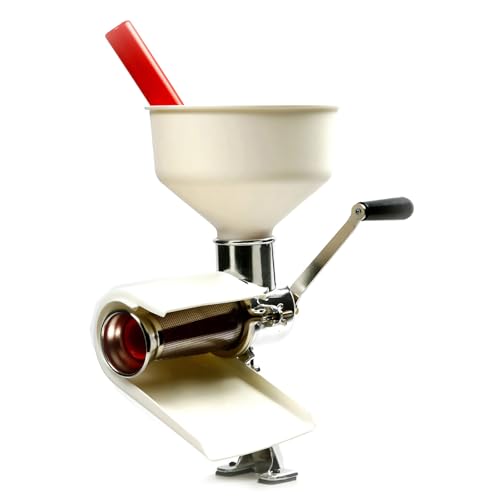
- 3-quart capacity for fruits and vegetables
- Separates juice and pulp in one operation
- Fine screen and standard spiral included
Best For: Manual sauce, soup, and puree preparation
Compact Manual Pureeing
OXO Good Grips Stainless Steel Food Mill

- 2.3-quart stainless steel bowl
- Three discs for different textures
- Non-slip legs and dishwasher-safe design
Best For: Manual hot-food purees and sauces
Continuous Harvest Processing
VEVOR Electric Tomato Strainer

- Steady motor output for continuous processing
- Four screens from 1mm to 6mm
- 304 stainless steel parts and cleaning brush
Best For: Large-batch canning and varied sauce textures
Best Stainless Steel Pick

- Durable 18/10 stainless steel construction
- Stable three-support base for bowl use
- Includes two grinding disc sieves
Best For: Manual batch cooking with sauces, soups, jams, and mashes
Best Manual Capacity

- Large 5-quart working capacity
- Designed for mashing and pureeing
- Simple manual rotary operation
Best For: Larger manual batches of mashed and pureed foods
Best High-Volume Electric Option

- Wide 9-inch hopper for large batches
- 450W electric motor reduces manual effort
- 304 stainless steel food-contact components
Best For: High-volume tomato sauce and fruit processing
Commercial Kitchen Workhorse
Winco 9-inch Commercial Food Mill

- 2-quart capacity for medium batches
- Interchangeable plates for varied textures
- Manual, corrosion-resistant construction
Best For: Medium-sized batches and professional-style food preparation
Canning-Day Classic
Hungry Artisan 3-Disc Food Mill

- Three discs for coarse to fine textures
- Separates skins, seeds, and cores
- Stainless steel manual construction
Best For: Applesauce, tomato sauce, and home canning
Extended-Prep Specialist
Hungry Artisan 4-Disc Food Mill

- Four discs include an ultra-fine option
- Comfort-grip, spring-loaded hand crank
- Stable hooks and dishwasher-safe steel
Best For: Canning, preserving, and extended batch preparation
Batch-Powered Electric Straining – Weston Deluxe Tomato Strainer
For shoppers comparing food mills for large batches, the Weston Deluxe Electric Tomato Strainer is built to process garden harvests and bulk produce efficiently. Its 1-gallon hopper, 250-watt motor, reverse function, and three stainless steel screens support sauces, purees, jellies, and salsa.
Best For: Large-batch tomato processing, preserving, sauces, and varied puree textures.
Pros:
- 1-gallon hopper helps handle larger quantities without frequent refilling.
- Two motor speeds include reverse to help prevent jamming.
- Three screens support fine, medium, and chunky preparations.
Cons:
- Requires access to a 120-volt AC outlet.
- Its 14-by-12-by-17-inch footprint may need dedicated storage space.
The Weston is a strong fit when throughput matters more than compactness. The included stomper and multiple screens add useful convenience for harvest-season processing.
Classic High-Capacity Straining – Norpro 1951 Sauce Master
The Norpro 1951 Sauce Master is a practical option among food mills for large batches, with a 3-quart capacity for processing fruits, vegetables, and purees. Its chrome-plated steel screen separates juice and pulp, while optional screens expand its uses.
Best For: Home cooks making sauces, soups, baby food, and fruit purees in moderate-to-large quantities.
Pros:
- 3-quart, or 95-ounce, capacity supports substantial batches.
- Separates smooth juice from pulp in one operation.
- Includes a fine mesh screen, standard spiral, recipe booklet, and guide.
Cons:
- Additional berry, pumpkin, and salsa screens are sold separately.
- Hand wash only; it should not be placed in the dishwasher.
The Sauce Master offers useful capacity without relying on an electric motor. It is a sensible choice if you want a versatile strainer and are comfortable with hand washing and optional accessory purchases.
Compact Manual Pureeing – OXO Good Grips Stainless Steel Food Mill
The OXO Good Grips Stainless Steel Food Mill suits shoppers who need food mills for large batches but prefer a manual, pot-over design. Its approximately 2.3-quart bowl handles hot foods, and three grinding discs provide fine, medium, and coarse textures.
Best For: Manual purees and sauces made directly over bowls or pots up to 11 inches in diameter.
Pros:
- Stainless steel bowl is suitable for hot foods and resists staining.
- Three discs offer fine, medium, and coarse results.
- Non-slip legs help secure the mill over compatible bowls and pots.
- Foldable legs simplify storage, and the mill is dishwasher safe.
Cons:
- Its 2.3-quart capacity is smaller than the electric and 3-quart alternatives.
- Manual operation may require more hands-on effort for very large batches.
The OXO emphasizes control, easy disc changes, and stable placement rather than maximum throughput. Choose it for flexible small-to-medium batch work and straightforward cleanup.
Continuous Harvest Processing – VEVOR Electric Tomato Strainer
For continuous processing, the VEVOR Electric Tomato Strainer is a capable choice among food mills for large batches. Its motor delivers steady output for sauce making and canning, while four screens and a stainless steel filter support tomato sauce, jam, pumpkin puree, salsa, and juice.
Best For: Harvest-season canning and extended electric processing across several sauce and puree textures.
Pros:
- Designed for continuous sauce making and large-batch canning.
- Four included screens cover 1mm, 1.5mm, 3mm, and 6mm textures.
- 304 stainless steel parts resist fruit acids and wear.
- Removable core components and a cleaning brush support rinsing.
Cons:
- The product notes list 300 watts rated power and 800 watts maximum, which may require careful comparison with other motors.
- At 7.2 pounds, it is less lightweight than a compact manual mill.
The VEVOR stands out for sustained processing and screen variety. Its guard cover may also help limit splatter, making it appealing for users handling substantial quantities of wet produce.
Best Stainless Steel Pick – Rosle 3-Liter Food Mill
Rosle 16252 Stainless Steel Food Mill with Handle, Bowl Rests & 2 Grinding Disc Sieves
Check Price On AmazonFor shoppers comparing food mills for large batches, the Rosle 16252 offers a durable manual design with a 3-liter capacity. Its stainless steel construction, close blade-to-sieve alignment, and stable bowl rests make it suited to sauces, soups, jams, fillings, and mashes.
Best For: Cooks who want a sturdy manual food mill for medium-to-large batches and varied kitchen tasks.
Pros:
- 3-liter capacity supports substantial batches.
- 18/10 stainless steel is durable, hygienic, and neutral in taste.
- Three lower supports help keep the mill stable over a bowl.
- Includes two grinding disc sieves for different preparations.
Cons:
- Manual operation requires more effort than an electric mill.
- Its 3-liter capacity is smaller than the 5-quart and electric options in this roundup.
The Rosle is a well-rounded choice when material quality, stability, and versatility matter more than maximum throughput. It is especially appealing for cooks who prefer a manual tool with a polished, one-piece design.
Best Manual Capacity – Tellier S3 5-Quart Food Mill
The Tellier S3 is a straightforward option for shoppers seeking food mills for large batches. Its 5-quart capacity gives it more room than many compact manual mills, while its rotary design is intended for mashing and pureeing.
Best For: Home cooks and food preparers who prioritize a larger manual capacity for mashing and pureeing.
Pros:
- 5-quart capacity is well suited to larger manual batches.
- Rotary design is made for mashing and pureeing.
- Tin-plated construction provides a traditional silver finish.
Cons:
- The supplied details do not specify included discs or other accessories.
- Manual rotary operation may be slower or more labor-intensive than an electric machine.
- Tin-plated construction may be less corrosion-resistant than stainless steel options.
Choose the Tellier when capacity is the main priority and you want a simple manual mill for purees and mashed foods. Its 5-quart size makes it a practical fit for larger preparations without adding an electric motor.
Best High-Volume Electric Option – 450W Tomato Sauce Maker
For the highest-throughput approach to food mills for large batches, this 110V electric sauce maker combines a 450-watt rating with a wide 9-inch hopper and a stated capacity of up to 110 pounds. It is designed to process tomatoes and other soft fruit into sauces and jams with less manual effort.
Best For: High-volume tomato sauce and fruit-processing sessions where speed and reduced hand cranking are priorities.
Pros:
- Electric motor and wide hopper are designed for large quantities.
- Food-contact components use 304 stainless steel for rust and corrosion resistance.
- Processes tomatoes, strawberries, blueberries, sauces, and jams.
- Tool-free disassembly is intended to simplify cleanup between batches.
Cons:
- It is substantially larger and heavier than manual food mills, at 21 pounds.
- Requires a 110V electrical connection.
- The supplied warranty description is limited to three months.
This is the strongest fit for production-style sauce days, especially when processing many pounds of tomatoes or fruit. The large hopper and motor prioritize throughput, while the stainless steel food-contact parts and removable design support repeated use and cleanup.
Commercial Kitchen Workhorse – Winco 9-inch Commercial Food Mill
If you need food mills for large batches, the Winco 9-inch Commercial Food Mill offers a durable manual design with a 2-quart capacity. Its stainless steel construction and interchangeable plates make it practical for preparing purées, sauces, soups, and other soft foods.
Best For: Medium-sized batches in busy home or professional kitchen settings.
Pros:
- Corrosion-resistant construction is suited to repeated kitchen use.
- Interchangeable plates allow different purée and sauce textures.
- Manual operation requires no outlet and supports straightforward cleanup.
Cons:
- The 2-quart capacity may be limiting for very large preserving projects.
- The notes identify the material as plastic despite the stainless-steel product description, so buyers should verify the construction details.
The Winco is a sensible choice when you want commercial-oriented durability and texture flexibility, but its stated capacity is better suited to medium batches than extended canning sessions.
Canning-Day Classic – Hungry Artisan 3-Disc Food Mill
For food mills for large batches, the Hungry Artisan 3-Disc Food Mill is designed around applesauce, tomato sauce, and canning work. Its hand crank separates skins, seeds, and cores while three stainless steel discs let you choose a coarse, medium, or fine texture.
Best For: Applesauce, tomato sauce, seasonal preserving, and flexible manual food preparation.
Pros:
- Three interchangeable discs provide useful texture control.
- Stainless steel body, discs, and crank are built for repeated use.
- Manual operation works anywhere without an outlet.
- Suitable for sauces, mashed potatoes, baby food, purées, and jam bases.
Cons:
- The supplied notes do not specify a capacity, making its suitability for exceptionally large batches harder to judge.
- Manual cranking may require more effort during extended processing.
This is a versatile preserving companion for cooks who value simple operation and three texture options. Check the available bowl or pot setup before committing to especially large batches.
Extended-Prep Specialist – Hungry Artisan 4-Disc Food Mill
Among food mills for large batches, the Hungry Artisan 4-Disc Food Mill stands out for texture control and extended manual prep. It includes four stainless steel discs, an ergonomic silicone-grip handle, a spring-loaded crank, and double-welded support hooks for steady work over bowls or pots.
Best For: Canning, preserving, tomato harvests, applesauce runs, smooth purées, and other extended home-kitchen prep.
Pros:
- Four discs offer options from coarse textures to ultra-fine purées.
- Ergonomic silicone grip and spring-loaded crank are designed to reduce hand fatigue.
- Double-welded support hooks help keep the mill stable over bowls and pots.
- Dishwasher-safe stainless steel construction supports easier cleanup.
Cons:
- The supplied notes do not state the mill’s capacity, so buyers should check dimensions and fit for their cookware.
- Manual operation can still be demanding when processing exceptionally large quantities.
This is the most feature-rich option of the three for cooks who need precise textures and comfortable handling through longer prep sessions. Confirm its capacity and pot compatibility for your particular batch size.
How We Picked the Best Food Mills for Large Batches
We focused on practical features that affect high-volume food processing: hopper capacity, processing speed, sieve options, construction, stability, and cleanup. The lineup includes electric tomato strainers for faster throughput, commercial-style rotary mills for repeated use, and manual models for cooks who want more control with less equipment.
We also considered versatility. A useful mill should handle more than one ingredient when possible, including tomatoes, apples, cooked vegetables, sauces, jams, and purees. Interchangeable discs or sieves are especially valuable when you need to switch between rustic and smooth textures.
Quick Comparison
| Type | Best For | Main Advantage | Trade-Off |
|---|---|---|---|
| Electric strainer | Tomato sauce and large harvests | Fast, continuous processing | Needs power and more storage space |
| Manual rotary mill | Purees, sauces, and occasional batches | Simple, quiet, and easy to control | Requires physical effort |
| Commercial stainless model | Frequent cooking or food-service use | Durable construction and stability | Often heavier and more expensive |
| Multi-disc mill | Mixed recipes and texture control | One tool supports several consistencies | Disc changes and cleaning take time |
Key Buying Factors for Food Mills for Large Batches
Capacity and Throughput
For canning or processing garden harvests, choose a large hopper and a design that feeds ingredients continuously. Electric models generally reduce labor and are the better choice when you process many pounds at once. Manual mills can still work well if batches are moderate or electricity is unavailable.
Power and Motor Design
Check both rated and maximum wattage on electric models, along with the expected output rate. A higher advertised wattage does not automatically guarantee better performance, so look for a stable motor, suitable feed opening, and strainers designed for the foods you process.
Discs, Sieves, and Texture
Fine discs create smoother sauces and purees, while larger openings leave more texture. Multiple discs make a mill more versatile, but confirm that replacements are available and that the discs are easy to remove and wash.
Stability, Materials, and Cleanup
Stainless steel construction resists staining and is well suited to acidic foods such as tomatoes. Bowl rests, clamps, nonslip feet, and a broad base help prevent movement during use. Removable parts and dishwasher-safe components can make a major difference after a long processing session.
Who Should Buy Which Food Mills for Large Batches?
Choose an electric tomato strainer if you regularly process large tomato harvests, make sauce for canning, or value speed over compact storage. A manual rotary mill is a better fit for cooks who want quiet operation, precise control, and a tool that can be used anywhere. Select a commercial stainless model if the mill will see frequent, demanding use or needs to withstand a busy kitchen.
For the broadest recipe range, prioritize a model with several grinding discs. If your main goal is tomato sauce, a dedicated electric strainer may be faster and less tiring. Before buying, measure your available counter and storage space, verify the included accessories, and make sure the mill’s capacity matches your typical batch size.