Choosing among pressure canners for home use depends on more than quart capacity. Heat-source compatibility, pressure control, batch size, storage space, and ease of monitoring all affect how confidently you can preserve low-acid foods.
This roundup compares 10 popular stovetop and electric models to help you match your canning habits, kitchen setup, and budget with the right pressure canner.
Best 10 Pressure Canners for Home Use Picks for 2026
Large-Batch Classic
Presto 23-Quart Pressure Canner

- 23-quart capacity for large batches
- Works on regular and smooth-top ranges
- Includes dial gauge, rack, and recipe book
Best For: Large home-canning sessions and versatile stovetop use
Three-Setting Value
MIRRO 22-Quart Aluminum Canner

- 22-quart capacity for large batches
- Includes 5, 10, and 15 PSI regulators
- Two racks and cool-touch handles included
Best For: Flexible stovetop pressure canning with multiple PSI options
Electric Convenience
NESCO NPC-9 Smart Pressure Canner
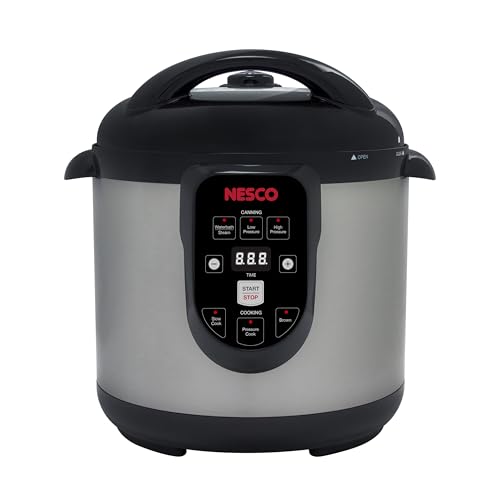
- Digital controls with automatic regulation
- Multiple cooking and canning modes
- Includes canning and steam racks
Best For: Programmable electric canning and everyday multi-function cooking
Induction-Ready Workhorse
Presto 23-Quart Induction Canner

- Compatible with induction and other stovetops
- 23-quart capacity for large batches
- Includes gauge, safety lock, and 12-year warranty
Best For: Large-batch canning on induction or mixed stovetop kitchens
Best for Built-to-Last Canning

- 21.5-quart capacity for large batches
- Metal-to-metal seal and manual pressure gauge
- Made in the USA from cast aluminum
Best For: Durability-focused home canners who prefer manual control
Best Digital Pick for Beginners
Presto 02153 Digital Pressure Canner

- 23-quart capacity for large batches
- Guided digital controls and LED display
- Automatic temperature and altitude management
Best For: Beginners seeking convenient, hands-free canning
Best Value for Versatile Batches
T-fal 22-Quart Pressure Canner

- Supports pressure and boiling-water canning
- Multiple jar capacities and two included racks
- Three PSI settings with an easy-to-read gauge
Best For: Manual canners preserving varied foods and batch sizes
Automated Pick
Presto 17-Quart Digital Pressure Canner

- Automated controls with LED process guidance
- 17-quart capacity for larger batches
- Works for pressure and boiling-water canning
Best For: Convenient, larger-batch home canning
Manual Value
Presto 16-Quart Aluminum Pressure Canner

- Traditional manual operation
- 16-quart capacity for larger batches
- Lightweight, warp-resistant aluminum body
Best For: Experienced home canners who prefer simple manual control
Compact Digital
Presto 12-Quart Digital Pressure Canner

- Automates pressure and water-bath canning
- Digital interface guides each step
- Ten built-in safety features
Best For: Versatile everyday home preservation
Large-Batch Classic – Presto 23-Quart Pressure Canner
For shoppers comparing pressure canners for home use, the Presto 01781 is a roomy manual option designed for substantial canning sessions. Its 23-quart aluminum body works on regular and smooth-top ranges, and it also doubles as a boiling-water canner and large pressure cooker.
Best For: Home canners who want a large-capacity stovetop model for vegetables, meats, poultry, seafood, fruits, and preserves.
Pros:
- Holds up to 7 quarts, 20 pints, or 26 half-pints.
- Works on regular and smooth-top ranges.
- Includes a pressure dial gauge, canning/cooking rack, and 76-page instruction and recipe book.
- Backed by an extended 12-year limited warranty.
Cons:
- Manual operation requires monitoring the pressure gauge.
- Its large footprint may be inconvenient for smaller kitchens.
This is a practical pick when batch size matters more than automation. The aluminum construction keeps it relatively light for its capacity, while the dual canning functions add everyday versatility.
Three-Setting Value – MIRRO 22-Quart Aluminum Canner
The MIRRO 22-quart model is a straightforward choice among pressure canners for home use, offering generous capacity and three pressure settings. Its aluminum construction, dual racks, and included regulators suit large-batch preserving and pressure cooking.
Best For: Home canners who want 5, 10, and 15 PSI options for processing large batches of vegetables, meats, poultry, and seafood.
Pros:
- 22-quart capacity supports large-batch canning.
- Includes regulators for 5, 10, and 15 PSI settings.
- Comes with two racks and dual cool-touch handles.
- Mirror-polished exterior is designed for easier cleaning.
Cons:
- Not suitable for contact with very acidic or very salty foods.
- Aluminum construction may not suit shoppers seeking a stainless-steel body.
- Manual operation still requires hands-on monitoring.
The MIRRO emphasizes capacity and pressure-setting flexibility at a practical price point. Review the material limitations carefully, but consider it if you primarily preserve suitable low-acid foods in sizable batches.
Electric Convenience – NESCO NPC-9 Smart Pressure Canner
For those seeking pressure canners for home use with less stovetop monitoring, the NESCO NPC-9 uses digital controls and automatic pressure regulation. It also offers pressure cooking, slow cooking, steaming, and water-bath modes for broader kitchen use.
Best For: Beginners and busy home cooks who prefer programmable electric operation for canning, cooking, and meal preparation.
Pros:
- Automatic pressure and temperature regulation reduces manual guesswork.
- Digital presets and timer support repeatable cycles.
- Includes canning and steam racks plus a removable condensation catcher.
- Safety lock lid and automatic float valve help prevent opening under pressure.
Cons:
- Its 9.5-quart capacity is smaller than the large stovetop models here.
- At 22 pounds, it is relatively heavy to move and store.
- Includes a one-year warranty.
The NESCO is the convenience-focused option in this group. Its programmable design can simplify routine processing, while the extra cooking modes make it useful beyond canning season.
Induction-Ready Workhorse – Presto 23-Quart Induction Canner
The Presto 01784 stands out among pressure canners for home use because its stainless-steel-clad base is compatible with induction, gas, electric, and smooth-top stoves. It combines a full 23-quart capacity with manual pressure control and boiling-water canning capability.
Best For: Large-batch home canners who use an induction range or want one stovetop canner compatible with multiple cooking surfaces.
Pros:
- Works on induction, gas, electric, and smooth-top stoves.
- Holds 7 quarts, 20 pints, or 26 half-pints.
- Includes a precise pressure gauge and air vent/cover lock.
- Has a heavy-gauge aluminum body, stainless-steel-clad base, and 12-year limited warranty.
Cons:
- Manual operation requires monitoring pressure during processing.
- Its full-size design may require substantial storage space.
This is the strongest fit for households with induction cooktops that still want traditional, large-batch stovetop canning. Its broad stovetop compatibility also makes it a flexible long-term choice when kitchen equipment changes.
Best for Built-to-Last Canning – All American 1930 921
For shoppers seeking pressure canners for home use with a traditional, durable design, the All American 1930 921 offers a 21.5-quart cast-aluminum body and a metal-to-metal sealing system. It works on gas, electric, and flat-top stoves and can also be used as a pressure cooker.
Best For: Experienced home canners who prioritize long-term durability, manual pressure control, and large-batch versatility.
Pros:
- Holds up to 18 pint jars or 7 one-quart jars.
- Precision-machined metal-to-metal seal helps provide a dependable steam-tight closure.
- Includes two canning racks, a pressure gauge, and a precision regulator weight.
- Made in the USA from heavy-duty cast aluminum.
Cons:
- At 22 pounds, it is relatively heavy to move and store.
- Manual operation requires monitoring pressure settings during use.
- The metal-to-metal closure design may require more hands-on setup than a digital model.
The All American 1930 921 is a strong choice when construction quality and serviceable, manual operation matter more than automation. Its large capacity and broad stovetop compatibility make it a dependable option for regular home preservation.
Best Digital Pick for Beginners – Presto 02153 Digital Pressure Canner
The Presto 02153 stands out among pressure canners for home use because its digital controls, guided prompts, and automatic temperature management reduce the need for stovetop monitoring. Its 23-quart capacity supports both pressure and boiling-water canning.
Best For: Beginners and busy home cooks who want guided, hands-free processing with a large batch capacity.
Pros:
- Automatically maintains processing temperature without constant burner adjustment.
- Digital display and step-by-step prompts make operation approachable.
- Automatic altitude adjustments and built-in safety systems add convenience.
- Holds up to 7 quart jars and supports pressure and boiling-water canning.
Cons:
- Requires a 120-volt electrical outlet and uses 1100 watts.
- Its 15.5-inch depth, 17.3-inch width, and 17-inch height require substantial storage space.
- Digital controls may be less appealing to shoppers who prefer a traditional manual canner.
For a more guided approach to home preservation, the Presto 02153 combines generous capacity with automatic operation. It is particularly appealing if monitoring a stovetop canner feels intimidating or inconvenient.
Best Value for Versatile Batches – T-fal 22-Quart Pressure Canner
The T-fal 22-Quart Aluminum Pressure Canner is a practical option for pressure canners for home use, combining pressure and boiling-water canning in one manual unit. Its three PSI settings, included racks, and canning guide support a range of home-preservation tasks.
Best For: Home canners who want a versatile, large-capacity manual model for both low- and high-acid foods.
Pros:
- Supports pressure canning for meats, vegetables, and seafood as well as boiling-water canning.
- Offers space for up to 24 half-pint, 16 wide-mouth pint, 18 pint, or 7 quart jars.
- Includes two canning racks and a step-by-step canning guide.
- Features three PSI settings, a locking lid, steam release valve, and easy-to-read gauge.
Cons:
- Compatible with gas and electric coil cooktops, but flat-top compatibility is not listed.
- Manual operation requires hands-on pressure management.
- Its large dimensions may make storage challenging in smaller kitchens.
The T-fal offers a well-rounded feature set for shoppers who want one canner for both pressure and water-bath projects. Its multiple rack configurations and included guide make it especially useful for processing varied batch sizes.
Automated Pick – Presto 17-Quart Digital Pressure Canner
The Presto 02152 is a convenient choice among pressure canners for home use if you want automated processing and room for larger batches. Its digital controls guide the process, while the sensor maintains the required temperature without constant monitoring.
Best For: Home canners who want an automated 17-quart unit for pressure and boiling-water canning.
Pros:
- Automates processing with a programmable control system and LED digital display.
- Extra-tall 17-quart capacity accommodates quart jars and larger batches.
- Supports both pressure canning and boiling-water canning.
- Designed for high-altitude pressure canning without adjustments.
Cons:
- At 24.3 pounds, it is relatively heavy to move and store.
- The 14.5-inch depth and 18-inch height require substantial counter or cabinet space.
Choose this model if convenience and capacity matter more than a compact footprint. The automated operation is its main advantage for repeat canning sessions.
Manual Value – Presto 16-Quart Aluminum Pressure Canner
The Presto 01755 is a straightforward option for pressure canners for home use, using manual controls and a durable, warp-resistant aluminum construction. Its 16-quart capacity is suited to preserving foods such as meats, fish, jams, and jellies.
Best For: Home cooks who prefer a traditional manual aluminum pressure canner with generous capacity.
Pros:
- 16-quart capacity supports substantial canning loads.
- Warp-resistant aluminum construction keeps the unit relatively light at 10.5 pounds.
- Manual operation offers a simple, traditional canning approach.
- Includes an air vent and cover lock for added convenience.
Cons:
- Manual operation does not provide the automated temperature control or digital guidance of the electric models.
- Its aluminum material may be less appealing to shoppers specifically seeking stainless steel construction.
This is a practical fit for experienced users who want a lighter, manual canner without programmable controls. It offers useful capacity while keeping the design uncomplicated.
Compact Digital – Presto 12-Quart Digital Pressure Canner
The Presto 02144 combines digital guidance with a more compact 12-quart capacity, making it a versatile choice among pressure canners for home use. It automates both pressure and water-bath canning, with settings for low-acid foods as well as fruits, jams, jellies, and salsa.
Best For: Home cooks seeking an automated canner for both pressure and water-bath preservation.
Pros:
- Automates pressure canning and water-bath canning in one appliance.
- Digital interface and LED icons guide users through each processing stage.
- Designed for low-acid foods including meat, poultry, fish, and vegetables.
- Includes ten built-in safety features, including a cover-locking system.
Cons:
- Its 12-quart capacity is smaller than the other digital model in this roundup.
- At 20.5 pounds, it is still a substantial appliance for storage or countertop movement.
This model offers a strong balance of versatility and digital convenience. Consider it when you want one appliance for both pressure and water-bath canning but do not need the largest available capacity.
How We Picked the Best Pressure Canners for Home Use
We evaluated these models by looking at pressure-control options, usable capacity, heat-source compatibility, construction, monitoring features, included racks or accessories, and overall practicality for home food preservation. The selection includes traditional aluminum canners, induction-compatible designs, and digital electric canners.
Because pressure canning involves food-safety risks, buyers should always follow current USDA guidance, the manufacturer’s instructions, and tested processing recipes. A convenient feature does not replace correct pressure, time, altitude, venting, and cooling procedures.
Quick Comparison
- Best for large stovetop batches: 23-quart models such as the Presto 01781 and Presto 01784.
- Best for induction cooktops: The Presto 01784, which is specifically designed for induction compatibility.
- Best for electric convenience: The NESCO NPC-9 and Presto digital canners, which provide automated controls and guided operation.
- Best for durable traditional construction: The All American 921, featuring a heavy-duty metal-to-metal sealing design.
- Best for smaller storage needs: The 12-, 16-, and 17-quart options, which can suit occasional canners or smaller households.
Key Buying Factors for Pressure Canners
Capacity and Batch Size
Larger 21- to 23-quart canners are useful for processing multiple jars or taller jars in fewer cycles, but they take more storage space and may be heavier when filled. Smaller models are easier to handle and can be a better fit for limited kitchens.
Stovetop or Electric Operation
Traditional stovetop canners are generally straightforward and do not depend on an electronic control system. Confirm that the base works with your range, especially if you use induction. Digital electric models can simplify temperature and pressure management, but they require countertop space, an electrical outlet, and careful adherence to the appliance’s approved procedures.
Pressure Control and Monitoring
Look for clearly defined pressure settings, a dependable gauge or pressure indicator, and an easy-to-read regulator. Multiple PSI options may be valuable at different elevations, while digital controls can reduce manual monitoring. Verify whether the unit uses weighted gauges, dial gauges, or electronic sensors and follow the supplied calibration or testing guidance.
Materials, Sealing, and Maintenance
Aluminum is common because it heats efficiently and keeps these appliances relatively manageable. Stainless-steel components may improve durability or induction performance. Check how the lid seals, whether replacement gaskets and regulators are available, and how easily the vent, rack, and accessories can be cleaned.
Who Should Buy Which Pressure Canners for Home Use?
Choose a large stovetop model if you preserve garden harvests in substantial batches and already have a compatible range. Select an induction-compatible model if your cooktop requires a suitable flat base. An electric canner is appealing when guided controls and reduced stovetop monitoring matter most, particularly for users who value a more automated workflow.
For occasional canners, a smaller 12- to 17-quart model may be easier to lift, store, and use without overbuying. Serious frequent canners may prefer a larger-capacity unit or the All American design for its robust traditional construction. Before ordering, measure your storage area, confirm jar capacity, check your cooktop or outlet requirements, and make sure replacement parts and current instructions are readily available.